

So many gods, so many creeds, so many paths that wind and wind while just the art of being kind is all the sad world needs.
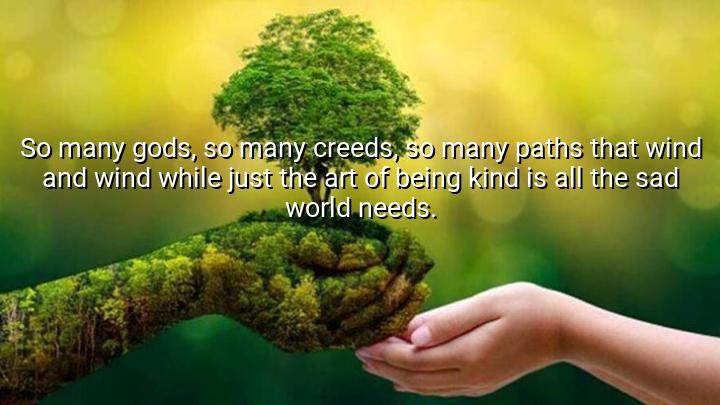




Ella Wheeler Wilcox’s quote, "So many gods, so many creeds, so many paths that wind and wind while just the art of being kind is all the sad world needs," reflects her belief in the universal power of kindness and its ability to transcend the divisions created by religion, beliefs, and philosophies. Wilcox acknowledges the vast number of religions, creeds, and paths that people follow, each representing different ways of seeking meaning and truth. However, she argues that amidst all these complex and varied ways of life, what the world truly needs is the simple, yet profound, art of being kind.
The phrase "the art of being kind" emphasizes that kindness is not just a passive or simple act but a skill or practice that can have a deep and transformative effect on the world. Wilcox suggests that kindness is a universal language that can cut through the complexities of human divisions and suffering. Unlike the many conflicting beliefs and paths that people may follow, kindness is something that can unite and heal, offering a way to bring people together despite their differences.
By referring to the world as "sad", Wilcox acknowledges the suffering and challenges people face in life. She believes that, regardless of one's beliefs or circumstances, kindness has the potential to alleviate this sadness, offering a solution that is both simple and powerful. The idea is that, while humanity may search for meaning in different ways, the true remedy to much of the pain and conflict in the world lies in the shared practice of compassion and understanding.
Ultimately, Wilcox’s quote underscores the importance of human connection through kindness as a means to foster peace and unity. It suggests that, amidst the complexities of life, the world would be better served if people focused on the fundamental, universal value of being kind to one another, transcending the differences that divide us. This timeless message encourages compassion as a solution to the world's deepest struggles.

GDGold D.dragon
This line is poetic but also painfully honest. It reminds me how often we focus on being 'right' rather than being kind. Why does it take so much effort to practice empathy, especially in a world that is already hurting? I’m left thinking: is kindness seen as passive when it might actually be the most revolutionary form of action? How can we encourage more people to embrace it in their daily lives?
KHTran Khanh Hang
I can’t help but feel both hope and sadness reading this. Hope, because the solution sounds so simple. Sadness, because if it really is that simple, why aren’t we doing it? It makes me wonder whether humans are hardwired to complicate life unnecessarily. How much suffering could be avoided if we prioritized kindness over dogma or doctrine? Is there a way to teach this early and universally across cultures?
MDMo Deochoacc
This quote makes me think about how often kindness is dismissed as naive or weak, even though it might be the most courageous act in a chaotic world. Why is it easier for people to rally around ideology than to simply be kind? I’m curious how we could reframe kindness as a strength and not just an emotional impulse. What would a world look like if kindness were a core value, not an afterthought?
NNguyet
Wilcox’s words feel timeless and tragically relevant. It’s unsettling how humanity continues to argue over belief systems while forgetting to practice basic compassion. What does it say about society that we’ve complicated life so much yet struggle with the simplest principle? Do we sometimes hide behind our ideologies to avoid the vulnerability of kindness? I think this quote forces us to confront how misplaced our priorities have become.
AQNguyen Van Anh Quyen
This quote strikes a deep chord. With all the division in the world—religious, political, cultural—it feels like such a simple truth is constantly overlooked. Why do we make kindness seem so complex or rare when it’s something within everyone’s reach? I wonder if kindness is undervalued precisely because it’s not loud or dramatic. Can the practice of kindness be the common ground where all differences dissolve?