

Simplicity and repose are the qualities that measure the true value of any work of art.
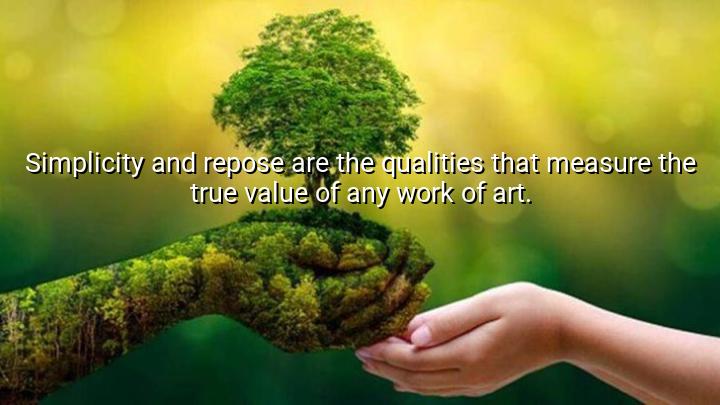




Frank Lloyd Wright’s quote, “Simplicity and repose are the qualities that measure the true value of any work of art,” reflects his enduring belief that great art should evoke a sense of calm, balance, and clarity. Wright, one of the most influential architects of the 20th century, often spoke of simplicity not as a lack of complexity, but as the refined expression of an idea—stripped of excess and focused on essential beauty. Similarly, repose refers to a sense of restfulness or stillness that invites reflection and emotional harmony.
Wright’s architectural philosophy emphasized the importance of organic design, where buildings harmonize with their environment and with the people who inhabit them. He believed that when a work of art or architecture possesses simplicity and repose, it communicates a universal truth—one that transcends style or era. His own works, such as Fallingwater and the Guggenheim Museum, embody these values through clean lines, open spaces, and a deep respect for natural forms.
The quote also pushes back against the idea that art must be ornate or overly elaborate to be meaningful. For Wright, excessive decoration or complexity can distract from a piece’s core essence. Instead, he found value in what is quiet, intentional, and timeless—qualities that allow the viewer to connect with the work on a deeper, more intuitive level.
Ultimately, Wright’s insight encourages both artists and audiences to seek the inner truth of a work of art. Through simplicity and repose, a piece reveals its authentic power—not through how much it shows, but through how gracefully it speaks to the human spirit. This principle continues to influence modern design and reminds us that true beauty often lies in restraint and serenity.

HQPham hieu quang
I find this quote beautiful but also a bit prescriptive. Isn’t the ‘value’ of art subjective? What if someone finds inspiration in chaos or movement rather than stillness? For example, abstract expressionism doesn’t exactly scream ‘repose,’ but it moved people deeply. So is Wright’s view too narrow, or is he just expressing a personal metric? I guess the bigger question is whether art even needs to be measured at all.
TNNguyen Thi Naruto
Do you think Wright is referring to simplicity in the visual sense, or is it more about conceptual clarity? Because some artworks appear simple but are layered with meaning, while others might be complex in appearance but shallow in thought. So, which kind of simplicity matters more—form or substance? I think this quote opens up a really nuanced conversation about what we actually value when we encounter art.
XDBui Xuan Do
This idea from Wright brings to mind Japanese aesthetics like wabi-sabi and the Zen philosophy of beauty in simplicity. But I’m curious—do all cultures define artistic ‘value’ this way? Might some traditions view vibrancy, detail, or even chaos as a sign of mastery? It’s interesting how one person’s peace might be another’s emptiness. Does this idea unintentionally narrow our appreciation of more eclectic or complex artistic forms?
TDNGUYEN THUY DIEM
I love this quote because it aligns with how I feel about architecture and design. But I wonder, in an age where digital and interactive art often relies on complexity, does Wright’s idea still hold? Can digital installations or AI-generated pieces that are inherently layered still achieve ‘repose’? Or are we entering an artistic era that measures value by engagement and novelty instead of calm and simplicity?
HNHan Nguyen
This quote really makes me think about how much modern art—and even modern design—leans toward complexity or chaos. Is Wright suggesting that restraint is more powerful than excess? I wonder how this applies across mediums: like, does a minimalist painting hold more inherent value than a richly detailed one? Or is it more about the feeling it evokes, regardless of style? It’s an intriguing challenge to how we assess artistic worth.