

Science fiction is any idea that occurs in the head and doesn't exist yet, but soon will, and will change everything for everybody, and nothing will ever be the same again. As soon as you have an idea that changes some small part of the world you are writing science fiction. It is always the art of the possible, never the impossible.
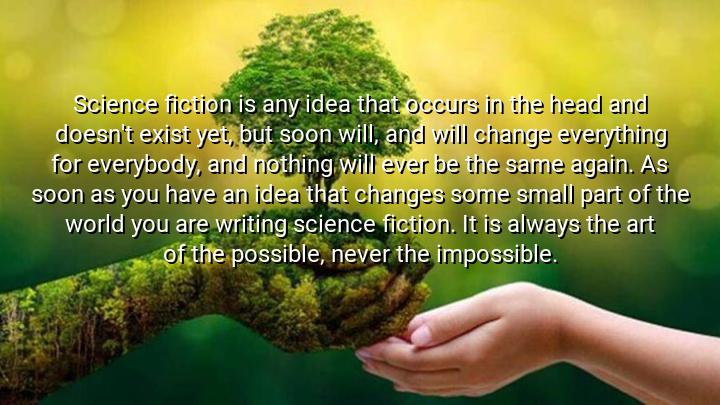




The quote " Science fiction is any idea that occurs in the head and doesn't exist yet, but soon will, and will change everything for everybody, and nothing will ever be the same again. As soon as you have an idea that changes some small part of the world you are writing science fiction. It is always the art of the possible, never the impossible" by Ray Bradbury offers a broad and inclusive definition of science fiction. Bradbury, a prolific author known for works like Fahrenheit 451, emphasizes that science fiction is not just about fantastical, futuristic worlds, but about ideas that stretch the imagination and predict changes that have yet to occur. According to him, science fiction is rooted in the possible, the innovations that can transform society, and the way they alter everyday life.
In this definition, science fiction is framed as a creative exploration of potential futures, driven by ideas that could one day shape reality. Bradbury highlights that even the smallest shift in the world—whether it’s a new technological development, a societal change, or a breakthrough in human understanding—can be considered science fiction if it has the potential to radically transform the world. By focusing on what could happen rather than what is currently possible, Bradbury suggests that science fiction is a genre that allows us to explore human potential and the consequences of change.
Bradbury also clarifies that science fiction is not about portraying the impossible, but rather the possible—what could eventually happen with advancements in science, technology, or human thinking. It deals with the plausible outcomes of ideas that challenge existing boundaries and norms, whether it's space exploration, artificial intelligence, or social movements. This makes science fiction a genre rooted in the future, but grounded in current or emerging possibilities rather than fantasies that cannot be realized.
In essence, Bradbury’s quote underscores that science fiction is more than just a genre of entertainment—it is a way of thinking about how the world could evolve. By exploring ideas that are not yet realized, it offers a glimpse into possible futures and encourages reflection on the ways new developments could impact humanity. For Bradbury, science fiction is a tool for imagining the future, driven by the art of exploring the possible and the inevitable changes that lie ahead.

HTVu Hoang Thuan
Bradbury’s quote makes sci-fi sound almost inevitable—like once you imagine something plausible, the future starts shifting. But that raises a question: what about the ideas that don’t catch on or never come true? Are they still science fiction? Or does the genre require a kind of belief that what’s imagined will someday be real? It makes me think about how much of sci-fi is speculation, and how much is subconscious prediction.
HL14. Ha Lan
I’m fascinated by the idea that science fiction starts with a single idea that 'changes some small part of the world.' That shifts the focus from big spectacles to subtle transformations. Could a short story about a new kind of communication or a different way to live also be sci-fi? I’ve always thought of it as tech-heavy, but this opens it up to emotional and cultural shifts too. It’s a broader, more inclusive vision of the genre.
TSHau Thi Su
Bradbury’s view feels like a call to action for creators. It makes me wonder—if sci-fi is about realizing the possible, then are we underestimating its role in innovation? How many real-world technologies were first imagined in fiction? Smartphones, virtual reality, even AI. Is it fair to say sci-fi might be one of humanity’s most important creative tools? This quote has me thinking about the genre as more than just storytelling—it’s a kind of blueprint.
NHNguyen Huong
I really love the optimism in this quote. Bradbury seems to believe that sci-fi is inherently progressive—it opens doors and shifts paradigms. But is that always true? Some science fiction can be cautionary, even bleak. Think of Orwell or Atwood. Are those stories still about the 'art of the possible'? Or are they warning us about what shouldn’t be possible? I wonder how Bradbury would interpret stories grounded in fear rather than hope.
TTTran Kim Tu Trinh
This quote makes me rethink what science fiction actually is. I always thought of it as spaceships and aliens, but Bradbury’s take is way more philosophical—it’s about impact. That’s exciting, but also a little overwhelming. Are writers of sci-fi responsible for envisioning ethical futures too? If their ideas are shaping what's possible, does that come with a moral obligation? It’s interesting to think of sci-fi not just as entertainment, but prophecy.