

Religion and art spring from the same root and are close kin. Economics and art are strangers.
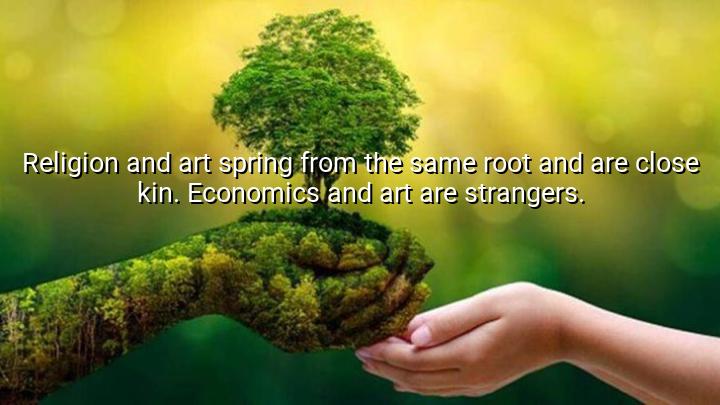




The quote " Religion and art spring from the same root and are close kin. Economics and art are strangers" by Nathaniel Hawthorne explores the deep connection between art and religion, suggesting that both arise from similar sources of human inspiration and creativity. Hawthorne implies that religion and art both deal with profound, often transcendent experiences and emotions, seeking to express the spiritual and mystical aspects of human existence. Both are forms of expression that aim to connect people to something greater than themselves, whether it's through the divine in religion or through the symbolic and emotive power of art.
Hawthorne contrasts this deep connection with economics, suggesting that art and economics are fundamentally disconnected. Economics is concerned with materialism, trade, and the practical concerns of survival and wealth, while art seeks to elevate the human spirit and explore the inner workings of the mind, heart, and soul. For Hawthorne, the world of economics and art operates on entirely different planes, with art often rising above the mundane concerns of material wealth to focus on deeper, more meaningful pursuits.
The idea that religion and art are "close kin" reflects the way both attempt to express and understand the mysteries of life, offering a way to comprehend the divine, the eternal, or the unknown. In religion, rituals and symbols are used to represent the unseen, while art similarly uses symbols, forms, and colors to evoke emotions and communicate complex ideas about existence and the human experience. Both seek to inspire reflection, awe, and a deeper understanding of the world and our place in it.
Ultimately, Hawthorne's quote emphasizes that art is a spiritual and emotional pursuit, whereas economics deals with practical realities. By linking art and religion, Hawthorne highlights their shared role in elevating human thought and expression, while distancing them from the world of commerce and materialism, where art might be seen as less valued or understood.

N7_24_ hoang minh yen nhi 7a16
This quote feels very timely in an era of AI-generated art, NFTs, and influencer culture. If art and religion are kin, then has our digital economy forced a divorce between inspiration and intent? I’m curious whether art can still serve a spiritual function in such a commercialized space—or has it become something else entirely? Maybe the challenge now is to find ways for art to preserve that sacred root even amid economic noise.
TPHuynh Thi Thu Phuong
I love how this quote prioritizes the emotional and metaphysical roots of creativity, but I’m also left wondering: can economics be an art form too? Think of architecture, industrial design, even branding—where art and commerce intersect in surprisingly meaningful ways. Maybe the issue isn’t whether they’re strangers, but whether we’ve allowed profit to become the only measure of worth. That’s the real danger, perhaps—not economics itself, but its dominance.
HDHai duong
Could this be a nostalgic take from Hawthorne, idealizing a time when art was more about devotion than demand? I respect the sentiment, but I also question whether it unintentionally dismisses the creative labor of artists trying to earn a living. Is it fair to say art and economics are strangers when so many artists are forced to straddle both worlds just to sustain their work? Maybe it’s not kinship or opposition—but tension.
NBTram Tran Ngoc Bao
Does this mean that commodifying art somehow distorts or diminishes its essence? I’ve always wondered if artists feel torn between creating for truth or for the market. When art becomes a product, does it lose its sacred edge? Maybe this is why some of the most powerful art feels raw or unpolished—it hasn’t been tailored for consumption. I’d be curious how artists personally reconcile this divide in their own practice.
KNKhang Nguyen
This quote makes me think deeply about the purpose behind creative expression. Is the kinship between art and religion about shared transcendence—both reaching for the ineffable? If so, is economics inherently opposed to that because it’s grounded in material value? I'd love to explore how artists navigate this tension: creating work that comes from a spiritual or emotional place while living in a world that measures value in currency.