

Really I don't like human nature unless all candied over with art.
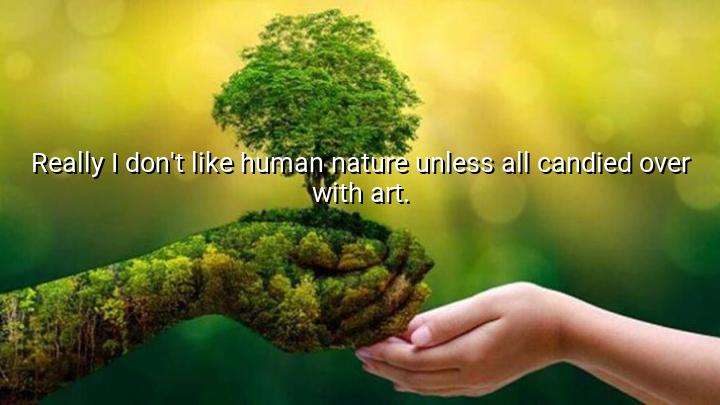




The quote "Really I don't like human nature unless all candied over with art" by Virginia Woolf reflects the writer's complex view of the human condition and the role of art in making life more palatable or meaningful. Woolf, an influential modernist author known for works like Mrs. Dalloway and To the Lighthouse, suggests that human nature can be difficult to appreciate without the lens of art to soften or enhance its harshness. For her, art acts as a filter that transforms the rawness of human experiences into something more aesthetically pleasing or intellectually enriching.
In this quote, the phrase "candied over" implies that art has the ability to sweeten or refine the inherent complexities and imperfections of human nature. Woolf may be commenting on the often bleak or mundane aspects of life, and how art serves to elevate those aspects, giving them beauty, depth, or a sense of purpose. By "candied over," she suggests that art provides a form of escape or a way to cope with the less pleasant realities of the human experience.
Woolf's view may also point to her broader exploration of the tension between the raw, unpolished aspects of life and the polished, idealized forms found in art. In her works, she often examined the internal struggles of her characters and the disconnect between their inner worlds and the external reality. Art, in Woolf's philosophy, allows these internal realities to be expressed, offering a more refined and engaging version of human nature that resonates with deeper truths about life.
In essence, Woolf's quote expresses her belief that art is essential for making sense of the complexities of human nature. Without the transformative power of art, she suggests that human nature might be too raw or unappealing to fully appreciate. Through art, life can be imbued with beauty and meaning, offering a way to engage with the world in a more reflective and enriching manner.

GDGold D.dragon
This quote reminds me of how I sometimes can’t stand the news or social media until I read a novel or watch a film that makes sense of it all. Maybe that’s what Woolf meant—art doesn’t hide human flaws, but repackages them in ways we can handle. Is that coping, or is it essential to how we find meaning in a messy world? It’s an open-ended dilemma.
DPTran Dinh Phuc
There’s something deeply poetic and paradoxical in Woolf’s sentiment. On one hand, it’s a clear critique of humanity; on the other, it’s a celebration of art’s power to transform. Does this suggest that truth alone is too harsh without the softening influence of creativity? Or is she making a deeper point about the necessity of imagination in how we engage with one another?
KDLe Nguyen Kha Di
Woolf seems to express a longing for beauty in the face of human imperfection. I resonate with this, especially in times when people feel overwhelmingly selfish or cruel. But it raises a question: does relying on art to make human nature bearable mean we're avoiding reality? Or is it simply a way to process and understand it more compassionately? There’s a fine line between interpretation and avoidance here.
TDAnh Thu Do
I find this quote a bit jarring, honestly. It feels like Woolf is saying she doesn’t appreciate people unless they're somehow artistically enhanced. Is that a fair or elitist stance? At the same time, I kind of get it—art can reveal beauty, structure, and meaning in things that might otherwise feel chaotic or unkind. Still, does this attitude risk alienating the raw, unadorned truth of real life?
UGUser Google
This quote makes me question whether Virginia Woolf saw art as a form of escape or a method of transforming the mundane. Is she being playful here or deeply disillusioned? Either way, it implies that raw human behavior—unfiltered—might be too harsh or uninspiring. I’d love to hear what others think: Is art a filter that elevates humanity or a mask that hides it?