

Pictures must not be too picturesque.
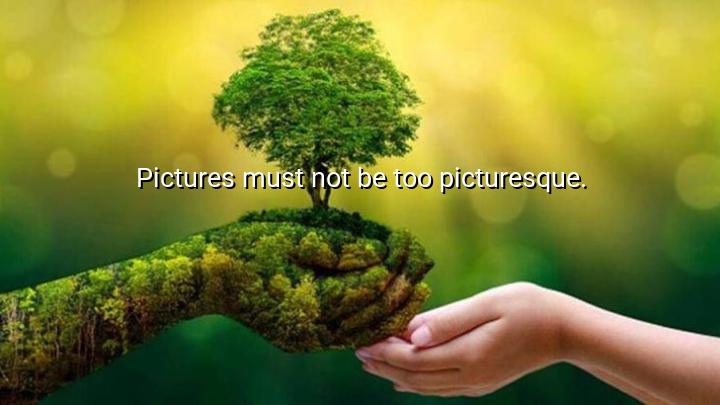




The quote " Pictures must not be too picturesque" by Ralph Waldo Emerson speaks to the idea that art, particularly visual art, should not be limited to mere surface beauty or conventional representations. Emerson, a philosopher and essayist, often challenged the notion of art as just an aesthetic pursuit. By saying that pictures must not be "too picturesque," he suggests that art should go beyond simply creating a pleasing or idealized image. Instead, it should engage with deeper meanings, provoke thought, and capture more than just the superficial appearance of the world.
Emerson’s statement reflects his broader philosophy about art and nature, emphasizing that art should reflect the complexity and truth of the world, not just the beauty that is easy to see or romanticize. If pictures are too picturesque, they may become overly idealized or sentimental, losing their ability to convey a deeper, more genuine perspective. Instead of simply replicating reality in a beautiful form, art should challenge the viewer, invite reflection, and offer insights beyond what is immediately visible.
This idea can also be seen as a critique of overly formulaic or clichéd depictions in art, where the goal is to please or satisfy the viewer without offering anything new or thought-provoking. Emerson seems to advocate for art that captures the essence of life, which is often messy, complex, and imperfect, rather than idealizing it into something merely pleasing to the eye.
Ultimately, Emerson’s quote encourages artists to push beyond the traditional boundaries of beauty and engage with the true essence of what they are depicting. By avoiding the trap of being "too picturesque," art can move toward a more meaningful, authentic expression that resonates on a deeper level with the viewer.

TPThu Phuong
This quote unsettled me a little, to be honest. I love picturesque images—the symmetry, the colors, the serenity. But Emerson’s words suggest that these elements might be superficial or even misleading. Is he saying that true art shouldn’t just be visually appealing, but should also challenge, confront, or reveal something deeper? I’d love to hear how others interpret this in the context of modern digital art and photography.
LDngoc lan dinh
Emerson’s comment feels like a subtle critique of romanticized or idealized imagery. It makes me question: should artists intentionally resist making their work ‘too perfect’ to preserve authenticity? Or is there value in the picturesque if it serves a deeper message? I think there’s a balance—sometimes beauty can draw people in, but maybe too much beauty becomes a kind of lie. How do we recognize when that line’s been crossed?
LLam
I'm curious what Emerson meant by ‘too picturesque.’ Is he criticizing art that focuses more on surface-level beauty than substance? That would make sense—after all, if a picture is too focused on pleasing the eye, does it risk becoming decorative instead of thought-provoking? I’m wondering how this idea translates to photography today, especially in a world flooded with perfectly curated Instagram shots. Are we losing something real in the process?
CPNguyen Cong Phuoc
This quote really challenges the modern obsession with polished visuals. Could it be that Emerson believed overly scenic images distract from deeper meaning or emotional impact? It makes me think about how some of the most powerful photos or paintings I’ve seen weren’t traditionally ‘pretty’ at all—they were messy, emotional, even unsettling. Is visual discomfort sometimes more honest or moving than visual harmony?
LPLuna Phan
Is Emerson warning us against the danger of aesthetic excess? It feels like he’s suggesting that when an image becomes too refined or ‘perfect,’ it loses something essential—maybe its truth or soul. I wonder if he’s advocating for rawness or imperfection as a truer form of artistic expression. It’s a compelling idea in a world where we’re constantly chasing visual perfection. What exactly is lost when things look too 'beautiful'?