

Patience is the art of hoping.
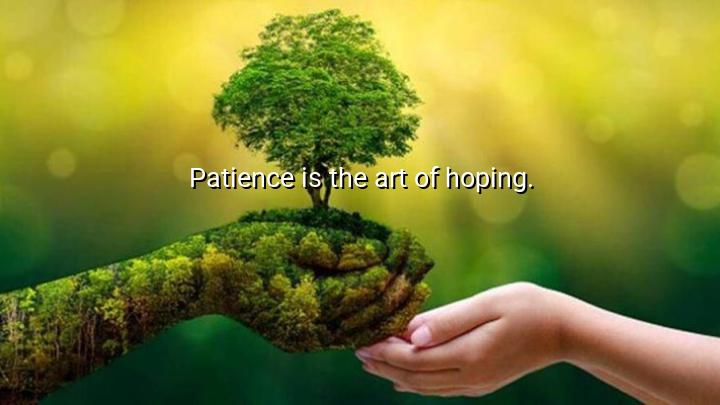




In this quote, Luc de Clapiers suggests that patience is not just about waiting passively, but is an art rooted in hope. He emphasizes that patience requires a sense of optimism and belief that, over time, things will unfold or improve. To practice patience is to remain hopeful and positive, even when results are not immediately visible. The act of waiting patiently is often driven by the expectation that something good will come to fruition, making hope the underlying force that sustains the ability to wait.
The origin of the quote lies in the philosophical thinking of Luc de Clapiers, a French philosopher known for his work on morality and human nature. In his writings, particularly in his famous work Reflections or Sentences and Moral Maxims, de Clapiers explored the concept of virtue and the emotional balance required to live a meaningful life. He believed that patience, a virtue often tested in times of adversity, is closely tied to hope, as it involves trusting in outcomes that are beyond one’s immediate control.
De Clapiers' statement also speaks to the psychological aspect of patience. It implies that the emotional strength required for patience is rooted in the belief that something positive is on the horizon, even if it isn't yet apparent. This view reframes patience from being a passive endurance of waiting to a more active, hopeful, and emotionally engaged process. It’s about maintaining faith during challenging times and holding onto the belief that things will improve with time.
Ultimately, this quote highlights that patience is a dynamic quality that requires both inner strength and faith in the future. It is not just about enduring a waiting period but doing so with the hope and belief that the desired result will come, making it an active and vital practice. By linking patience with hope, de Clapiers shows that true patience is not just about enduring hardship, but about staying positive and hopeful as we wait for the best possible outcome.

GBGia Bao
To me, this quote elevates patience from a frustrating necessity to something more beautiful and intentional. But I wonder—how do we differentiate between being patient and being stagnant? Hope is a wonderful motivator, but it can also keep people stuck in situations that aren’t healthy or realistic. When is it time to let go of hope and move on, rather than continuing to be patient?
THTHU HIEN
Linking patience with hope makes patience feel less like passive endurance and more like a courageous act. But it also raises a question—can someone be hopeful but impatient at the same time? I often feel like I deeply believe something good is coming, but I still struggle with waiting for it. Does that mean my hope isn’t strong enough, or just that I haven’t mastered this 'art' yet?
TNDang Thi Nghia
This quote struck a chord with me because I’ve often struggled to be patient. Seeing it framed as an 'art' makes me wonder—can it be learned like a skill? And if so, what’s the best way to practice it? Is it through mindfulness, discipline, or just living through tough moments? I’d be really interested in hearing how others cultivate this kind of hopeful endurance in their own lives.
RTrom thuy
I appreciate the idea that patience isn't just waiting, but waiting with a sense of purpose and belief. But what about those situations where hope seems unrealistic? Does patience still have value if the hoped-for outcome is unlikely or impossible? I guess I'm asking whether hope and realism can coexist within patience—or if this kind of patience sometimes crosses into self-deception.
HDTrinh Thi Huyen Dieu
I find this quote quite poetic and almost romantic in its simplicity. It connects patience to an emotional virtue rather than just a behavioral one. But I’m wondering: in a world of instant gratification, how do we teach ourselves or others this form of hope-driven patience? Is it something you can develop intentionally, or does it come naturally through hardship and experience?