

Only in art will the lion lie down with the lamb, and the rose grow without thorn.
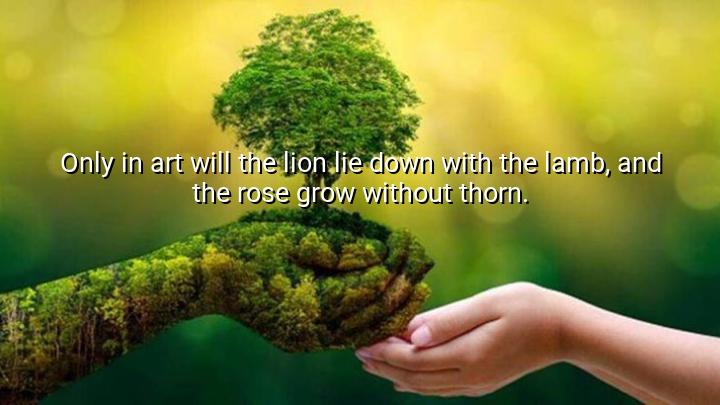




Martin Amis’ quote, "Only in art will the lion lie down with the lamb, and the rose grow without thorn," explores the idea that art has the unique ability to create harmony and beauty in ways that are often impossible in real life. The image of the lion lying down with the lamb, traditionally seen as a symbol of opposites—strength versus innocence or aggression versus peace, suggests that art has the power to reconcile conflict and unite seemingly incompatible forces. Similarly, the idea of a rose growing without a thorn symbolizes perfection and beauty free from pain or struggle, a condition that art can sometimes achieve but that is rare or unattainable in the real world.
The quote reflects Amis’ belief in the idealized nature of art, where the constraints and harshness of life can be transcended. In art, there are no limits to imagination, and it allows for the creation of idealized worlds where opposites can coexist peacefully, and beauty can flourish without the usual consequences of imperfection or suffering. This sets art apart from life, where conflict and suffering are inevitable parts of the human experience.
Amis’ statement also touches on the transformative power of art. Through creativity, art can elevate our understanding of the world by presenting idealized versions of reality that reflect our hopes, desires, and aspirations. These representations allow for a momentary escape from the realities of life, offering a space where peace, beauty, and harmony can exist without the usual complications and contradictions that define the human experience.
Ultimately, the quote reinforces the idea that art provides an outlet for creating visions of perfection and harmony, offering a temporary reprieve from the inherent flaws and struggles of the real world. It invites us to imagine a world that is not bound by the same limitations, where peace and beauty can exist without the presence of conflict or suffering.

TMtran thu minh
What a fascinating metaphor. It makes me think of how artists can bring together contradictory emotions or ideas in a single piece—fierceness and vulnerability, chaos and calm. Maybe that’s what makes art so moving: it holds contradictions in balance. Still, I wonder whether this balance is sustainable or just symbolic. Can we ever carry that harmony outside the frame and into our lives?
SLSon Le
There’s something almost biblical about this quote—it evokes the kind of peace we rarely, if ever, see in real life. I wonder if Amis is hinting at the divine or transcendent power of art, where even natural laws are rewritten. But does that mean art is inherently disconnected from truth? Or is it a deeper truth that shows us not how things are, but how they might be?
LPLy Phuong
This quote is incredibly beautiful and evocative. It makes me think of how art allows us to dream of unity and perfection, even when the real world feels broken and chaotic. But is this dream helpful or harmful? Can imagining a world without conflict help us move toward peace, or does it set up unrealistic expectations? It’s such a complex balance between vision and delusion.
CMNguyen Chi Mai
I’m curious about what Amis means by saying that only in art can this perfect peace exist. Is he suggesting that art is inherently utopian, or just that it’s the only place where we dare to imagine utopia? It makes me think about how art functions psychologically—does it give us a safe place to explore ideal scenarios that can’t exist in life? And if so, does that have therapeutic value?
DSDoctor Strange
Amis’s quote strikes me as both poetic and deeply idealistic. It makes me think about how art can create spaces of pure imagination where the impossible becomes real. But does this vision of art risk disconnecting it from reality? Shouldn’t art also reflect the world as it is—with all its thorns? Or is its value precisely in offering escape, however temporary, from the world’s harshness?