

One's art goes as far and as deep as one's love goes.
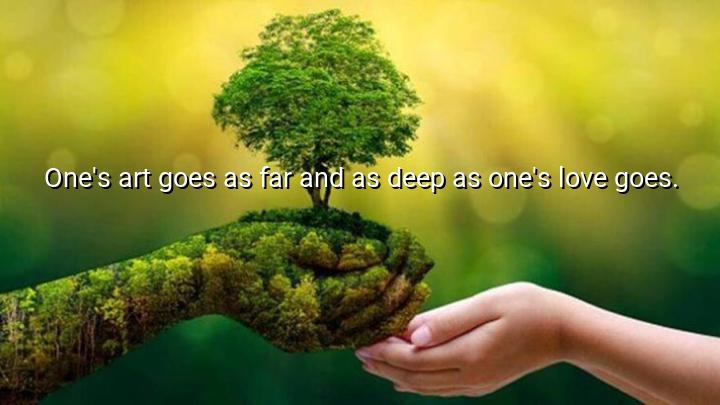




In this quote, Andrew Wyeth suggests that the depth and impact of an artist's art are directly connected to the love they have for their subject, medium, or life itself. He implies that art is not merely a technical skill, but a deeply emotional expression that reflects the artist's inner feelings. The more love an artist has—whether for their craft, their subjects, or their creative process—the more powerful and meaningful their art becomes. Love, in this sense, is the driving force that fuels the depth and authenticity of their creative expression.
The origin of the quote lies in Wyeth’s own approach to art, where he often painted with deep emotional resonance. Known for his realistic and sometimes haunting depictions of rural life, nature, and the human form, Wyeth’s works often convey a profound connection to his subjects. This quote reflects his belief that true artistry comes from the heart, and that the quality of art is an extension of the artist’s emotional investment. For Wyeth, the act of creating art was intrinsically tied to his affection and attachment to what he depicted.
Wyeth’s statement also touches on the personal and intimate nature of the artistic process. He suggests that art is not a detached or purely intellectual endeavor, but a form of love that involves a deep emotional connection. An artist’s love for their work, their subjects, or even the creative journey itself infuses the artwork with authenticity and meaning, giving it emotional weight that resonates with viewers.
Ultimately, this quote invites us to consider the role of emotion in the creation of art. Wyeth’s view emphasizes that the best art is born from the heart, and its depth and impact are directly linked to the love and passion the artist invests in their work. The more deeply an artist loves their subject or their craft, the more profound and lasting the artistic experience becomes, both for the artist and the audience.

VTVan Tran
There’s something really romantic and almost spiritual about this quote, but I also wonder—is it entirely true? Can someone who’s emotionally distant or damaged still create profound art? Sometimes pain, rather than love, drives creativity. Or maybe Wyeth saw love and suffering as intertwined. I’m curious whether he believed love had to be joyful and nurturing, or if love could also come from a darker, more complex place.
DBNguyen Duy Bach
This quote has me thinking about the role of emotional intent in art. Does this mean that someone making art for fame or profit will never achieve the same depth as someone creating out of love? Or can love take different forms—like love for storytelling, aesthetics, or even for self-expression? I think Wyeth might be inviting us to consider love as a guiding force, not just a feeling.
SSjjaja
Wyeth’s words suggest that love is the real engine behind artistic depth, not talent or training. That’s powerful. But it also makes me think: how do we measure love in the context of art? Is it seen in the time invested, the honesty expressed, or the vulnerability shared? And can an audience ever truly sense the love that went into a piece, or is that something only the artist knows?
MHPhan Minh Huy
It’s such a moving idea, but also kind of intimidating. If my art only goes as far as my love does, does that mean I need to constantly be in a state of emotional openness to create something meaningful? That’s a lot of pressure. What happens when we’re feeling numb or disconnected—are we incapable of producing true art in those moments? This quote makes me question my own creative process.
TTThanh Tran
This quote really struck a chord with me. It makes me wonder—does the depth of an artwork depend entirely on the artist’s emotional capacity? If so, what does that mean for technically skilled artists who may not be emotionally expressive? Can love here be interpreted broadly—as in love for the subject, the process, or even humanity? I’d love to hear what kind of love Wyeth was referring to.