

One science only will one genius fit; so vast is art, so narrow human wit.
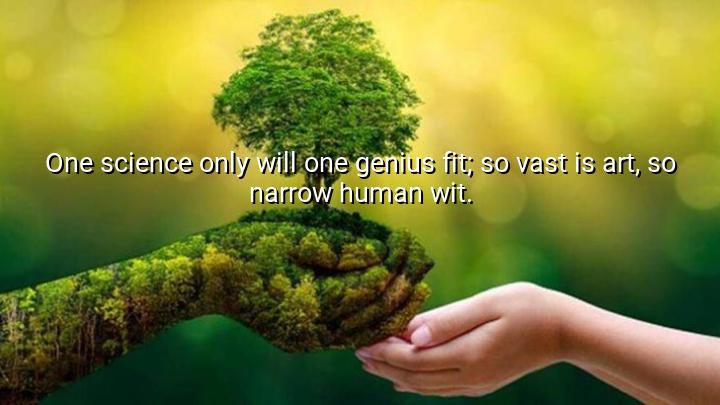




Alexander Pope’s quote, “One science only will one genius fit; so vast is art, so narrow human wit,” reflects his view on the limits of human intellect and the immense scope of knowledge and art. Pope suggests that while art and science are vast and complex fields, each person—no matter how brilliant—can truly master only a small portion. The phrase highlights the contrast between the breadth of knowledge and the limited capacity of the individual mind.
As one of the leading poets of the 18th century, Pope was known for his sharp wit and mastery of heroic couplets. This quote comes from his work An Essay on Criticism, which offers reflections on art, literature, and human nature. In this line, Pope cautions against overestimating one’s intellectual reach, reminding readers that even a genius must focus their talents narrowly to achieve true mastery.
The use of the term “one science” refers broadly to any discipline or field of study, while “so vast is art” implies that the full realm of creativity, expression, and knowledge is far too expansive for one person to fully comprehend. At the same time, “so narrow human wit” acknowledges the inherent limitations of human understanding, no matter how gifted an individual may be.
Ultimately, Pope’s quote encourages humility in the pursuit of knowledge and excellence. It recognizes the greatness of art and science while reminding us to be realistic about our own intellectual boundaries. In doing so, it underscores the value of specialization, focus, and the importance of collaborative effort in advancing human achievement.

DHDolly Haru
I love the poetic phrasing here, but it also makes me think—could Pope be underestimating the collaborative power of humanity? While one genius may not master the entirety of art or science, isn’t our strength in the collective? Through shared knowledge and creativity, we might be able to explore art’s vastness together, even if no individual mind can hold it all.
NMNGUYEN THI NHU MAI
Pope’s line raises a question for me about the nature of genius—does it lie in the ability to innovate within one narrow space, or in the ability to see connections across vast and unrelated fields? In other words, is specialization the hallmark of genius, or is true brilliance marked by synthesis and creative leaps between disciplines?
TLTu Tran Luu
This quote feels strangely relevant in a world obsessed with achievement and expertise. If even genius is only capable of mastering one science, does that mean we should stop pressuring ourselves to be experts in everything? Maybe it’s a reminder that depth matters more than breadth, especially in a time when multitasking and general knowledge are often glorified.
TYTuyen Y
I’m intrigued by the contrast between 'science' and 'art' here. Pope seems to frame science as something singular and focused, while art is portrayed as sprawling and infinite. Do you think that's an accurate depiction? Couldn’t the reverse be argued—that science has grown so complex and specialized today that even geniuses struggle to keep up with a single field?
GDGold D.dragon
This quote makes me wonder—does it imply that the arts are too complex for any one person to truly grasp in full? That feels both humbling and a little discouraging. If art is so vast and human wit so narrow, how do we reconcile the drive for mastery with the reality of limitation? Is it enough to pursue just a slice of the whole and still consider oneself an artist?