

One must always draw, draw with the eyes, when one cannot draw with a pencil.
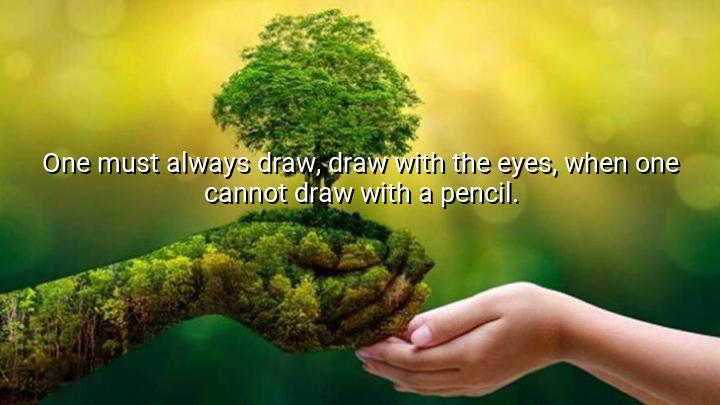




The quote "One must always draw, draw with the eyes, when one cannot draw with a pencil" by Balthus reflects the idea that art is not limited to physical tools like a pencil or brush, but also involves an active, mindful process of observation. Balthus suggests that when the physical act of drawing is not possible, one can still engage in the artistic process by mentally observing and visualizing the world around them. The eyes become a tool for capturing and understanding the essence of what one might want to draw, training the mind to see as an artist sees.
This quote highlights the importance of observation in the artistic process. Drawing is not merely about translating what is seen onto paper, but about deeply understanding and interpreting the world through the eyes. Even without a pencil, the act of visually exploring and mentally "drawing" allows an artist to refine their vision and creative expression. In this sense, drawing is not just a physical skill but a mental one, requiring focus and intent in perceiving the world.
Balthus, known for his precise and often provocative portrayals of figures and scenes, valued the discipline of both physical and mental drawing. His quote may also reflect the way artists engage with their environment, always learning and adapting, even when unable to produce physical works. This idea underscores the artist’s constant need to be in tune with their surroundings and to continually train their creative faculties, regardless of whether they are actively creating.
Ultimately, this quote is a reminder that art goes beyond the materials used to create it; it involves the ability to see and think like an artist at all times. Whether with a pencil or simply with the eyes, the act of drawing is an internal process that engages both the body and the mind in the pursuit of creative expression.

KTNguyen Kim Thao
This quote makes me nostalgic for how I used to experience the world as a kid—always watching, noticing tiny details, making mental pictures. Somewhere along the way, life got louder and I stopped 'drawing with my eyes.' Do you think this kind of visual sensitivity can be relearned in adulthood? Are there exercises or habits that help bring back that kind of observational focus?
DNSi dung Nguyen
It’s a beautiful sentiment, but I’m also a little troubled by it. For those who struggle with burnout or creative block, the pressure to be constantly observing—even passively—can be exhausting. Is there room in this mindset for rest? For simply being, without always seeing through an artistic lens? I'm curious how others reconcile the desire to stay creatively engaged with the need to step back and recharge.
BQNguyen Bao Quynh
I wonder how this quote applies to other forms of creativity. Can a musician 'compose with their ears' when they’re not writing? Or a writer 'write with the mind' while observing life in silence? It seems like Balthus is pointing to a kind of mental practice, a way of staying connected to one's craft even in moments of stillness. Do you think this mental engagement is as critical as physical practice?
VTVũ Trang
This statement makes me reflect on the discipline behind artistic perception. It’s not just about talent or output—it’s about constantly engaging with the world visually. But what does that look like in practice? Is it about noticing shapes in shadows, the movement of people, subtle color contrasts? I’d love to hear from visual artists—how do you keep your 'eyes drawing' when you're not physically sketching?
HLHien Le
Is Balthus suggesting that observation is just as valuable as creation? I find this quote really affirming, especially as someone who doesn’t consider themselves an artist in the traditional sense. It feels like he’s emphasizing the importance of seeing deeply—training your eyes to perceive composition, light, form, even when you're not actively producing. Do you think this kind of visual attentiveness can enhance everyday experiences, even outside the arts?