

One does not need buildings, money, power, or status to practice the Art of Peace. Heaven is right where you are standing, and that is the place to train.
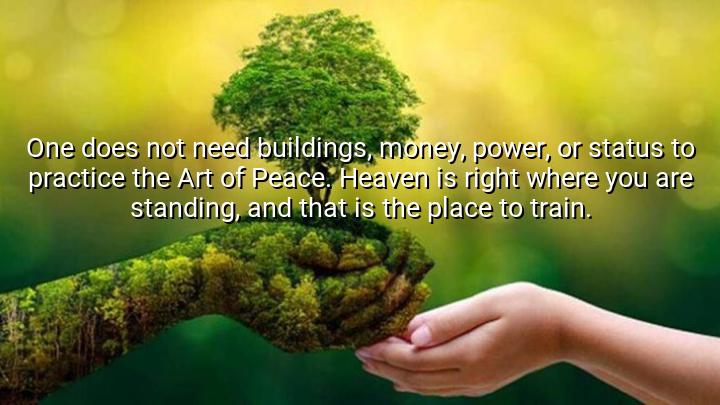




Morihei Ueshiba’s quote, “One does not need buildings, money, power, or status to practice the Art of Peace. Heaven is right where you are standing, and that is the place to train,” emphasizes the spiritual and personal nature of true discipline and growth. Ueshiba, the founder of Aikido, believed that practicing the Art of Peace—a philosophy rooted in harmony, compassion, and non-violence—does not require external advantages or material wealth. Instead, it begins with inner commitment and can be cultivated wherever one stands.
The “Art of Peace” refers not only to martial technique but to a broader philosophy of living, where conflict is resolved through understanding, balance, and unity, rather than force. Ueshiba developed this approach after years of martial training and spiritual reflection, blending traditional Japanese martial arts with profound ethical and spiritual insights. His quote rejects the notion that one must wait for the perfect conditions—such as access to facilities, social status, or financial means—to begin meaningful practice.
The phrase “Heaven is right where you are standing” captures Ueshiba’s belief in the sacredness of the present moment. Rather than searching for peace or enlightenment in distant places, he teaches that one can begin the journey now, with whatever tools or space are available. This reflects the essence of discipline, where true transformation arises from intention, presence, and awareness, not from external validation or luxury.
Ultimately, Ueshiba’s quote encourages a humble, grounded, and universal approach to self-improvement and spiritual growth. It is a reminder that the path to peace, both in martial arts and in life, begins not in grand settings or ideal circumstances, but in the here and now, with a heart dedicated to peaceful action and inner strength.

NTThao Nhi Tran
This makes me think of martial arts as more than physical discipline—it’s a path to spiritual clarity. But what exactly does the 'Art of Peace' look like in daily life? Is it about responding with compassion, staying grounded, or resisting ego-driven reactions? I’d be really interested in practical examples of how people live this out, especially outside a traditional dojo or spiritual setting.
TATran Tien Anh
There’s something really humbling in this quote. It reminds me that peace isn't a product of privilege—it's a mindset. But at the same time, it makes me wonder: if peace is so accessible, why is it still so rare? Do we lack the will to train, or are we simply distracted by modern comforts and status symbols that keep us from seeing what's already in front of us?
NTKim Ngan Nguyen Thi
What stands out to me is the concept of 'heaven' being right where we are. It’s empowering but also a bit abstract. If peace and enlightenment can be practiced anywhere, does that mean we’re overlooking the opportunities for growth in our everyday lives? I’d love to hear others' thoughts on how to consciously train in peace when life feels so ordinary or even stressful.
LTLe Thanh
Ueshiba’s words make me think about how self-discipline and inner transformation don’t require perfect conditions. It challenges the assumption that personal growth needs expensive retreats or ideal spaces. But is it always realistic? How does someone in a war zone or struggling with survival embrace this philosophy? I admire the spirit of it, but I’m curious how it holds up in extreme or unjust circumstances.
NNghia
This quote really resonates with me, especially in a world that often measures worth by material success. I love the idea that peace—and the discipline it takes to cultivate it—is something internal and universally accessible. But I wonder, how do we maintain that mindset in a chaotic environment? If our surroundings are filled with noise, stress, or conflict, can we still truly train ourselves in peace without some form of external support?