

Nothing is art if it does not come from nature.
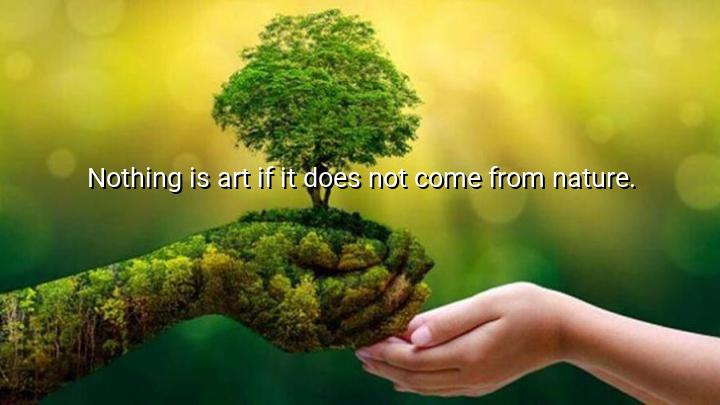




The quote "Nothing is art if it does not come from nature" by Antoni Gaudí reflects the artist's deep belief in the intrinsic connection between the natural world and the creative process. Gaudí, known for his extraordinary contributions to architecture, particularly through his work on the Sagrada Familia, saw nature as the ultimate source of inspiration. He believed that true art must be rooted in the forms, patterns, and principles found in nature, which he regarded as the purest and most perfect expression of beauty.
In Gaudí's view, nature provides a blueprint for artistic creation. The organic shapes, colors, and structures in the natural world, from the curves of plants to the formations of landscapes, influenced his architectural style. Gaudí's famous buildings often mimic the flowing, asymmetrical lines found in nature, showing that art should align with the natural order rather than impose artificial or rigid designs.
This connection between art and nature is particularly evident in Gaudí's use of natural materials and his focus on incorporating natural elements into his works. He often employed stone, wood, and glass to create structures that were not only functional but also in harmony with their surroundings. For Gaudí, nature was a teacher, and any creation that did not originate from its principles lacked authenticity and beauty.
Ultimately, Gaudí’s quote emphasizes that the essence of true art lies in its ability to reflect the natural world and its underlying harmony. By drawing from nature, artists can create works that are not only visually stunning but also imbued with deeper meaning and connection to the environment.

LNUyen Linh Ngo
Gaudi’s philosophy seems to suggest that nature is the most honest and pure source of creativity. But in a time when climate change and environmental degradation are huge issues, does this quote take on new meaning? Could it be a call for sustainable or nature-integrated design in modern art and architecture? I wonder how today’s creators can balance innovation with reverence for the natural world.
PDPhuong Do
This quote resonates with me, especially in a time when we’re increasingly disconnected from nature. Maybe Gaudi is reminding us to return to our roots and see the natural world as the original canvas. Still, how does this idea apply to performance art, poetry, or music—forms that aren’t necessarily visual or directly 'from nature' in the material sense? Is emotional authenticity a kind of natural essence too?
PAVu Phuong Anh
Reading this made me realize how much of modern art draws inspiration from technology, urban life, and synthetic experiences. Would Gaudi see these forms as detached from real artistry? Or is he suggesting that even those elements, in some way, originate from nature—since humans themselves are part of it? I’d love to hear how others interpret the scope of ‘nature’ in this quote.
LLNgoc Linh Le
Gaudi’s belief feels almost spiritual to me, like he’s placing nature on a divine pedestal as the ultimate muse. I wonder if this view might limit artistic freedom, though. Can something born entirely from the human psyche—like a surrealist dreamscape—still count as art if it doesn’t clearly tie back to the natural world? Where does imagination fit into this philosophy?
TPLinh Phung Thi Phuong
I appreciate Gaudi’s perspective, especially considering how his architecture mimicked natural forms so beautifully. But I’m curious—what does this say about abstract or conceptual art that doesn’t directly mimic or represent nature? Is it still considered 'true' art? This quote raises interesting questions about what qualifies as inspiration and whether nature must always be a visible influence in artistic expression.