

No great artist ever sees things as they really are. If he did, he would cease to be an artist.
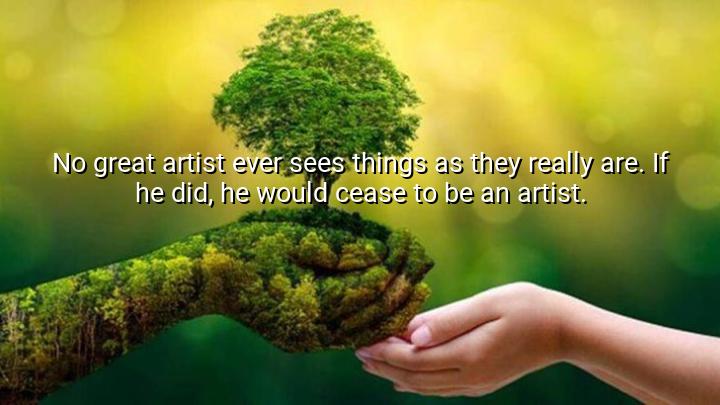




The quote "No great artist ever sees things as they really are. If he did, he would cease to be an artist" by Oscar Wilde suggests that artists do not simply observe the world as it is, but instead, they interpret, imagine, and re-envision it. Wilde argues that true artists are not bound by the literal or mundane realities of life but instead create their own subjective representations. This capacity for seeing beyond the surface is what allows them to produce innovative, original work that transcends ordinary perception.
In this context, Wilde is emphasizing the importance of imagination and transformation in art. If an artist were to see things exactly as they are—without any creative filtering or interpretation—they would lose their ability to transform the world into something new, inspiring, and meaningful. The role of the artist is to present the world in a way that evokes emotions, ideas, and reflections, often departing from realism to offer something deeper or more symbolic.
The origin of this quote lies in Wilde’s broader philosophical beliefs about art and its function in society. As a writer and playwright, Wilde often explored the tension between reality and imagination, particularly in works like The Picture of Dorian Gray and The Importance of Being Earnest. He believed that art should challenge conventional perceptions and offer new, creative ways of seeing the world, thus making the role of the artist inherently transformative.
By stating that "No great artist ever sees things as they really are," Wilde underscores the idea that art is about interpretation and imagination, not mere replication of reality. The true value of art lies in the artist’s ability to see beyond the surface and offer a new, enriched perspective that moves beyond the mundane and into the realm of the extraordinary. This perspective encourages us to embrace the creative and interpretative power of art, which allows us to experience the world in fresh and profound ways.

NVNhu Vu
I actually find this quote kind of comforting. It gives artists permission to see the world through their own lens, to make it stranger, softer, harsher—whatever they need it to be. But does this freedom come with responsibility? If artists don’t reflect 'reality,' how much liberty should they take before their work becomes misleading or detached from truth? Is there a point where too much imagination does a disservice to the audience?
GDGold D.dragon
This quote sounds like a rejection of objectivity in art. But what does Wilde mean by 'as they really are'? Reality is layered—emotional, physical, social. Maybe great artists just choose which layer to emphasize, revealing truths others might overlook. I’m curious whether Wilde meant this as a critique of realism or a broader philosophical statement about perception. Could this also apply to writers, filmmakers, or even scientists in a metaphorical sense?
DVDuong VIP
There’s something so Wildean about this statement—provocative, paradoxical, and poetic. But I wonder: is seeing things 'as they really are' even possible for anyone? Don’t we all filter reality through experience, culture, and emotion? If that’s the case, then maybe Wilde’s not talking about artists being different from the rest of us, but rather more aware of their subjective lens. Is that what sets a great artist apart?
DDDuy Duy
I feel torn by this quote. On one hand, it celebrates imagination and subjectivity, which I love. On the other hand, it almost feels dismissive of documentary-style or realist art. Artists like Dorothea Lange or Edward Hopper showed the world as it was, and still made powerful, moving work. So does this quote apply more to certain genres or styles? Or is Wilde speaking metaphorically about emotional rather than visual truth?
LLle linh
This quote makes me reflect on how perception works. Is Wilde saying that great artists are defined by their ability to reinterpret or reshape reality? That makes sense, especially when you think about how much of art is about symbolism, abstraction, or emotional expression. But does this mean someone who sees the world plainly can’t ever be a true artist? That feels like a harsh judgment—can't clarity also inspire brilliance?