

My trade and art is to live.
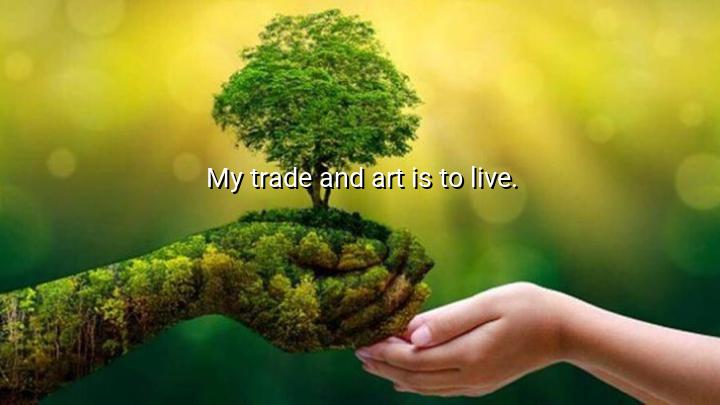




Michel de Montaigne’s quote, "My trade and art is to live," speaks to his philosophy that life itself is the greatest form of art and self-expression. Montaigne, a French philosopher and essayist, is known for his reflective and personal approach to understanding the human condition. In this statement, he suggests that the ultimate practice or craft one can pursue is not a profession or a specific skill, but the art of living itself—fully embracing life in all its complexities, joys, and challenges.
By referring to "trade and art", Montaigne elevates the ordinary act of living to the level of an artistic pursuit. He implies that the way we navigate our lives—our choices, our relationships, and our self-awareness—can be a form of creative expression. Just as an artist engages in a craft to create something meaningful, Montaigne sees life itself as an opportunity to engage in deep reflection, growth, and authenticity.
The quote also reflects Montaigne’s belief in the importance of experience and self-awareness. Rather than adhering to external rules or seeking external validation, Montaigne advocates for a life that is lived genuinely and intentionally. He emphasizes the value of reflecting on one’s own experiences and learning from them, which aligns with the broader themes of his Essays, where he explores the complexities of human nature, personal growth, and moral reflection.
Ultimately, Montaigne’s quote suggests that the art of living requires attention, introspection, and a commitment to living in a way that is true to oneself. Life, in his view, is not something to be passively endured but actively shaped and experienced as a form of art. This perspective encourages individuals to see life as a continuous journey of exploration and personal development, where every moment offers an opportunity to practice the art of truly living.

THTrang Huyen
I find Montaigne’s quote deeply liberating. It removes the pressure to create something tangible to be considered an ‘artist’ and instead focuses on living with intention. But how does this mindset coexist with societal expectations to produce, earn, and achieve? Can we live artfully in a world that often values output over presence? I wonder how this philosophy could change how we prioritize our time, relationships, and self-worth.
TV44. Ton Nu Tuong Vy
This idea challenges the notion that art is something outside of ourselves. If life is the art, then every choice we make—how we treat others, how we face hardship—becomes a brushstroke. But it also raises a question: is there a risk of romanticizing life too much? Can calling life an art lead us to ignore the mundane, difficult, or unjust aspects that aren’t so poetic?
HYNgguyen Thi Hoangg Yen
There’s something timeless in this statement. It makes me think about how the Renaissance valued the cultivation of self, not just external output. In today’s world, where productivity is everything, this quote almost feels rebellious. Can living—fully, mindfully, ethically—be seen as a creative act in itself? And if so, how do we measure it, or should we resist measuring it at all? Is that part of the artistry?
QTVu Quang Tu
I'm drawn to the boldness of calling life itself a ‘trade and art.’ But how does one become skilled at living? Are there techniques, like in any other art form? And what are the tools—self-reflection, empathy, courage? I think Montaigne invites us to consider that living well is not passive, but active and learned. That’s both inspiring and daunting. How do we know when we’re truly practicing the art of life?
ANDuc Anh Nguyen
Montaigne’s idea here is so elegant, yet so profound. It makes me wonder if we undervalue the experience of living because we’re too focused on producing or achieving. What if simply being present and intentional in life is its own kind of mastery? I’d love to explore how this perspective might shift our definition of success. Can a well-lived life be considered a masterpiece, even without traditional accomplishments?