

My art is a form of restoration in terms of my feelings to myself and to others.
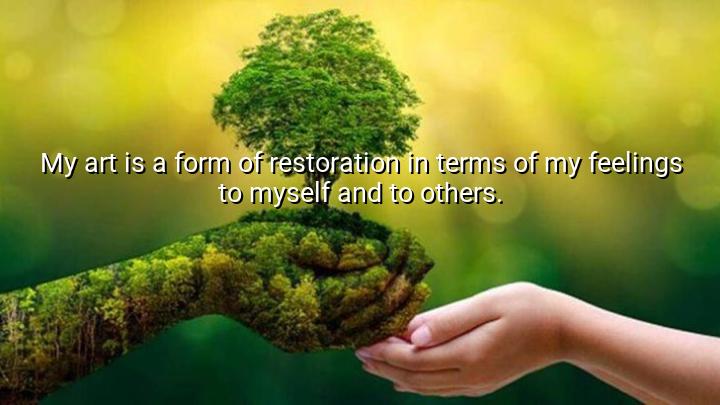




Louise Bourgeois’ quote, "My art is a form of restoration in terms of my feelings to myself and to others," highlights the therapeutic and healing role that art plays in her life. For Bourgeois, art is not just a means of creative expression, but a way to restore emotional balance and find reconciliation. The act of creating is deeply personal for her, serving as a method to process her feelings—both toward herself and the people in her life. Art, for Bourgeois, becomes a vehicle through which she can address personal experiences and emotions, particularly those linked to family, identity, and memory.
The concept of restoration implies that Bourgeois’ work is not merely about creating for external recognition, but about re-establishing a sense of internal peace or healing. She often drew upon her own life experiences, including her troubled relationship with her parents, to explore complex emotional themes. For Bourgeois, the creative process was a way of confronting and understanding past trauma, offering her a form of catharsis and healing. Through art, she could reclaim her emotional power and express feelings that might otherwise be difficult to articulate.
Bourgeois' art was often deeply introspective, confronting themes of suffering, vulnerability, and sexuality, and the restoration she speaks of was not just personal but relational. Through her work, she sought to explore how her emotions and experiences impacted her relationships with others, particularly those closest to her. The quote suggests that art, in her case, is a form of communication that allows her to bridge the gap between herself and others, making sense of her internal world and sharing it in a way that fosters connection.
Ultimately, Bourgeois viewed art as a restorative practice that offered both personal healing and the opportunity to engage with others. It allowed her to work through the complexities of her emotions and life experiences, giving her a way to restore her sense of self while also offering a shared space for others to understand and empathize with her journey.

LMle minh
I appreciate how deeply personal this sentiment is, but I’m left wondering about its implications for audience engagement. If an artist creates for restoration, are they still considering the viewer’s interpretation and experience? Or is that secondary? Can art that is so intensely self-focused still be universally relatable, or does it risk becoming too insular to truly connect with others?
HTLuu Thi Huynh Tram
The emotional depth of this quote made me feel a bit melancholic. It’s like she's saying that art fills a void or repairs emotional damage. That got me wondering: does this process ever become a crutch? Could the act of creating art as a means of restoration become dependent or even compulsive if the emotional wounds never fully heal?
NTNT TH
As a reader, this quote makes me think about the dual role of vulnerability in art—restoring oneself while simultaneously revealing that self to others. But doesn't that also open the door to misinterpretation or emotional exposure? How does one balance the need for restoration with the risk of being misunderstood, especially when emotions are being laid bare for public consumption?
VN28_ Doan Van Ngoi
I'm curious about how this idea might resonate with people who don't identify as artists. If someone doesn’t create traditional art, can they still achieve this kind of emotional restoration through other forms of expression like writing, cooking, or even gardening? Or is there something unique about the artistic process that makes it more conducive to self-healing and reconnection with others?
TH11_ Ly Tang Huu
Do you think it's possible for art to serve as a form of therapy for both the creator and the viewer, or is that too subjective to generalize? I find Bourgeois’ statement intriguing because it implies a healing process that's both internal and interpersonal. But I wonder how much of that 'restoration' is actually received or understood by others who experience the work. Can an artist’s emotional restoration truly translate through their medium?