

Music is God's gift to man, the only art of Heaven given to earth, the only art of earth we take to Heaven.
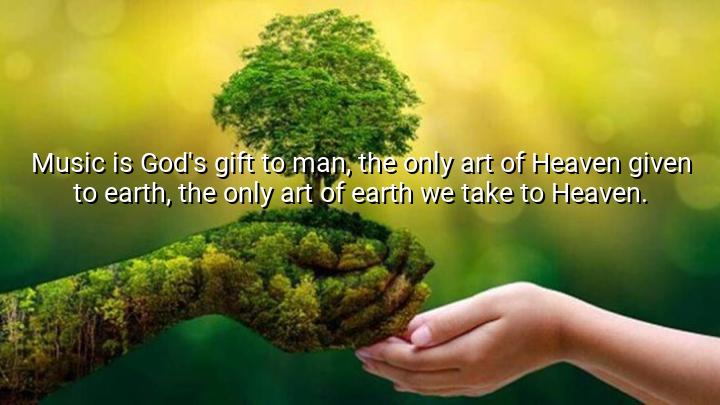




The quote "Music is God's gift to man, the only art of Heaven given to earth, the only art of earth we take to Heaven" by Walter Savage Landor reflects the profound, almost sacred nature of music. Landor, an English writer and poet, suggests that music is a divine gift, distinct from all other forms of art. It is the only form of creative expression that bridges the gap between the earthly and the spiritual, coming from Heaven to enrich human life and continuing beyond death, to be taken into Heaven itself.
Landor emphasizes that music holds a special place among the arts because it transcends material existence and has the ability to touch the soul. Unlike other forms of art, music is not just a physical creation but a spiritual experience, one that connects humans to something higher, whether it be the divine or the sublime. This idea reflects music’s unique ability to evoke deep emotions, stir the spirit, and express what words alone cannot capture.
The notion that music is the "only art of earth we take to Heaven" suggests its eternal and transcendent nature. While visual art, literature, and other forms of expression are confined to the physical world, music, in Landor's view, is an art form that transcends death and continues in the afterlife. It is an eternal language that resonates with the divine, representing the continuity of human connection to the spiritual world.
Ultimately, Landor’s quote elevates music to a sacred status, recognizing it as both a gift and a divine means of communication. It is not just a form of entertainment but a profound, spiritual expression that accompanies humans through life and beyond, making it a timeless and universal part of the human experience.

5Z5 Z
This quote stirs up so many feelings for me. I’ve had moments where a piece of music genuinely felt like it transcended time and space. But do you think that kind of experience is universal, or is it tied to personal memory and emotion? Maybe what Landor calls 'Heaven' is really that inner place where we feel completely alive. Is the divine nature of music something external, or does it live within us?
Ddmyha
There’s something very romantic about this idea, but I wonder—can music be considered divine even when it’s commercialized or created for profit? Not all music feels like a gift from Heaven, to be honest. Some of it feels manufactured, empty. Does intention matter in whether music retains this 'gift-like' quality? Or is the divine aspect about how it’s received by the listener, regardless of how or why it was made?
THLe Thu Huong
This quote got me thinking—if music is the one art we take to Heaven, what kind of music are we talking about? Is it sacred music, or does it include all genres, even punk rock or hip-hop? I guess it depends on whether the message, the form, or the feeling is what makes it eternal. It opens up a fascinating conversation about what kind of art we see as spiritually lasting.
QTVu Quang Tu
Landor’s view of music as a divine bridge is lovely, but I can’t help thinking about how music is also deeply human—shaped by culture, politics, struggle. Is it really 'of Heaven,' or is its power grounded in the way it reflects human experience? Maybe the fact that it can do both—feel divine while being rooted in emotion and story—is what makes it so unique. I’d love to hear others’ thoughts on that paradox.
DPQuoc Danh Pham
I find this quote beautiful and comforting. It captures something I’ve always felt but never articulated—that music connects us to something beyond ourselves. But do you think this idea depends on a religious worldview? For someone who doesn’t believe in Heaven or God, does music still hold that same weight? Maybe the quote still works metaphorically, but I’m curious how it resonates across spiritual or secular perspectives.