

Man's ultimate concern must be expressed symbolically, because symbolic language alone is able to express the ultimate.
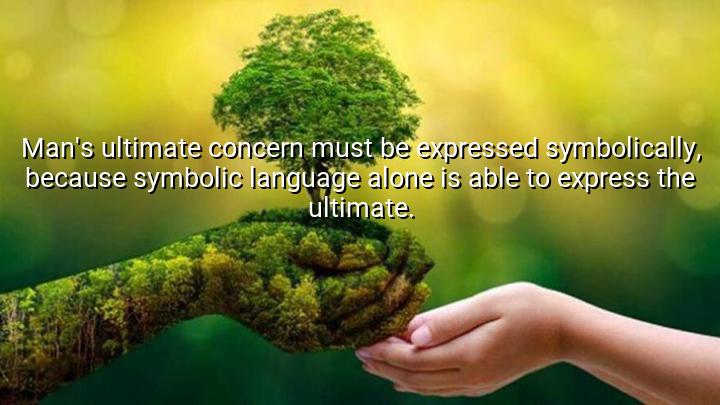




The quote "Man's ultimate concern must be expressed symbolically, because symbolic language alone is able to express the ultimate." by Paul Tillich addresses the limitations of language in expressing profound, abstract concepts such as existence, faith, and ultimate concerns. Tillich argues that our deepest beliefs, including questions about life's meaning and our relationship to the divine, cannot be fully captured by literal or everyday language. Instead, these profound ideas must be expressed through symbolic language, which has the ability to convey deeper truths and transcend the boundaries of ordinary communication.
Tillich’s assertion reflects his philosophical and theological views on the nature of religion and existence. In his work, he often explored how symbols (such as religious rituals, myths, and artistic expressions) provide a way to connect with the divine and with the mystery of human existence. According to Tillich, symbols are not just metaphors or representations, but essential tools that allow us to experience and articulate what is ultimately real—those things beyond our immediate comprehension or direct experience.
The quote emphasizes that symbolic language is uniquely suited to address ultimate concerns, such as our spirituality, purpose, and relationship to the infinite. This language is not limited by the constraints of everyday communication but allows for a more abstract and transformative way of expressing complex and deeply personal truths. Through symbols, humans can connect with the sacred or the transcendent, experiencing things that cannot be captured by words alone.
The origin of this quote comes from Paul Tillich, a German-American theologian and philosopher known for his work on systematic theology and existentialist thought. Tillich’s influential writings explore the intersection of philosophy, theology, and culture, and he is especially known for his concept of the "God above God" and his focus on symbolism as a crucial method for understanding the divine and existential realities. His approach to religion and philosophy deeply influenced 20th-century thought on faith, existence, and meaning.

PKPham Phu Khang
This quote raises questions about the role of symbols in modern life. In an age dominated by factual information and data, do we risk losing touch with symbolic expression? How can we balance the analytical with the symbolic to address ultimate concerns like meaning and purpose? Could renewed appreciation for symbolism lead to deeper human connection?
DMDuc Duong Minh
Tillich’s perspective suggests that symbols act as bridges between the tangible and the transcendent. How does this affect our approach to art and culture, which often rely on symbolism? Could understanding symbols better help us connect with others’ experiences or foster empathy? What challenges arise when symbols become outdated or misunderstood over time?
NNduong thi nhu ngoc
The quote invites reflection on the nature of human expression. Why might symbolic language be uniquely suited to convey ultimate concerns? Could it be because symbols evoke emotions and subconscious meanings that literal words miss? How does this insight influence the way we interpret literature, religious texts, or even everyday communication?
PLNguyen phuong linh
I find Tillich’s emphasis on symbolism thought-provoking. Could this imply that rational discourse falls short when addressing life’s deepest concerns? If so, what role should symbolism play in education, therapy, or philosophy? How might embracing symbolic language enrich our understanding of meaning, purpose, or identity in ways straightforward language cannot?
CDcuong Duong
This quote makes me wonder about the limitations of language. If symbolic language alone can express the ultimate, how do we navigate misunderstandings caused by differing interpretations of symbols? Are symbols universal, or do they rely heavily on cultural context? How does this shape communication about deep, personal, or spiritual matters across diverse groups?