

Being religious means asking passionately the question of the meaning of our existence and being willing to receive answers, even if the answers hurt.
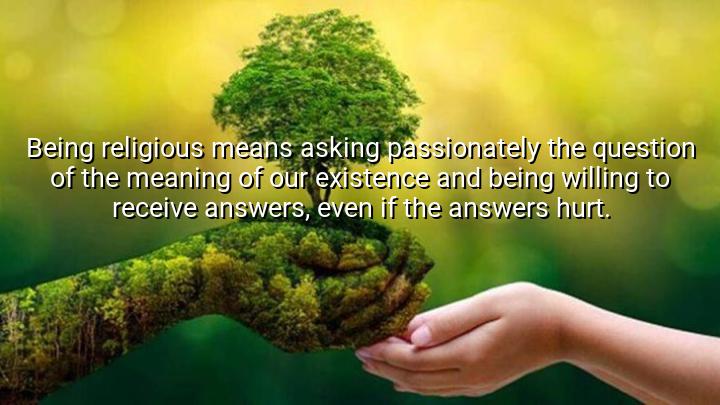




In this quote, Paul Tillich, a renowned German-American theologian and philosopher, presents a profound perspective on what it means to be religious. For Tillich, religion is not just about following rituals, traditions, or doctrines, but is deeply tied to a passionate inquiry into the meaning of existence. To be truly religious, in his view, means to confront the deepest questions of life, purpose, and human suffering, and to actively seek answers to these existential questions. Religion, in this sense, becomes a journey of continuous exploration rather than a static set of beliefs.
Tillich further suggests that being religious involves a willingness to receive answers, even when those answers are uncomfortable or challenging. Truth in matters of existence and faith may not always be comforting, and it can sometimes lead to difficult realizations about life, death, suffering, and our place in the universe. Tillich’s concept of religion requires an openness to truth and authenticity, acknowledging that the search for meaning might not always lead to simple or easy conclusions, but that these answers are integral to a deeper understanding of human life.
The quote emphasizes the existential nature of religion, which is central to Tillich's philosophy. He believed that religion should not shy away from hard truths or the anxieties that come with existential reflection. This approach aligns with his broader theological views, which integrated elements of existentialism, humanism, and Christianity. For Tillich, faith is about grappling with life’s big questions and embracing uncertainty, rather than seeking easy solutions or reassurance.
The origin of this quote is from Paul Tillich, a theologian known for his work in the 20th century that sought to reconcile Christian theology with modern existentialism. Tillich’s thought was deeply influenced by the trauma of the world wars and the growing existential questioning of human existence. His theological approach emphasized that true religion is not about escaping life's challenges but about engaging with them honestly and fearlessly.

AAdministratorAdministrator
Welcome, honored guests. Please leave a comment, we will respond soon