

Love of beauty is taste. The creation of beauty is art.
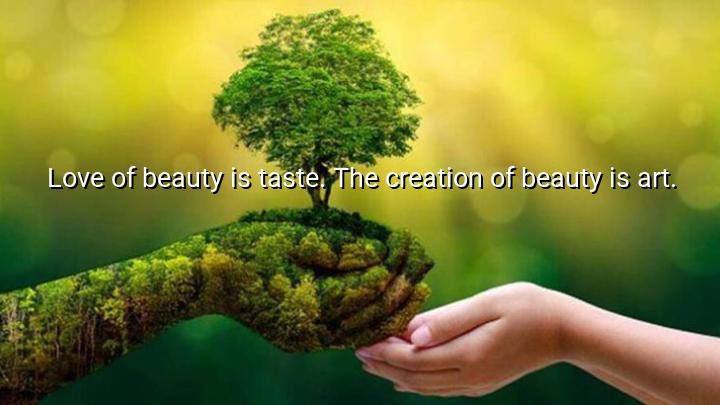




The quote "Love of beauty is taste. The creation of beauty is art" by Ralph Waldo Emerson distinguishes between taste and art, two concepts closely related to the appreciation and creation of beauty. Emerson, an American essayist, poet, and philosopher, suggests that taste refers to an individual's ability to recognize and appreciate beauty in the world around them. It involves an aesthetic sense, a personal preference for what is visually or emotionally appealing. Taste is subjective and can vary from person to person based on cultural background, experiences, and personal values.
In contrast, Emerson defines art as the active process of creating beauty. While taste is about appreciation, art is about creation and the ability to bring something beautiful into existence. Art requires skill, imagination, and vision, and is often seen as a higher expression of creativity, as it goes beyond mere recognition of beauty and instead seeks to form, shape, and manifest it in physical or conceptual forms.
Emerson’s quote suggests that while taste is a personal and passive quality—an appreciation for what already exists—art is a dynamic and transformative process. Art is the expression of the artist’s ability to craft and refine beauty, whether through visual art, music, literature, or other creative forms. It is a celebration of human creativity and the pursuit of something greater than ordinary beauty.
Ultimately, this quote emphasizes the idea that taste and art are both essential to our experience of beauty. Taste helps us recognize and enjoy beauty, while art allows us to create and share it with the world. Emerson highlights how both aspects of beauty are integral to the human experience, with taste guiding us and art enabling us to contribute to the world’s aesthetic richness.

YNPHUONG YEN NHI
This quote really nails the divide between consuming and producing. It feels especially relevant in our culture today, where so many people are surrounded by beautiful content but few actually make it. It makes me reflect on my own habits—do I spend more time enjoying art than attempting to create it myself? And does that mean I'm not participating in art, but just appreciating the surface of it?
NNu
There’s something quietly empowering about this quote. It makes me feel like art isn't just for those born with some special gift—it's something anyone can aspire to by moving beyond admiration into action. But at the same time, it raises the bar. If creating beauty is what makes something art, does that mean art that’s ugly, grotesque, or intentionally uncomfortable doesn’t count? How do we define 'beauty' in this framework?
GDGold D.dragon
I love how this quote separates appreciation from creation, but it also makes me question whether beauty is even objective. If beauty is in the eye of the beholder, then isn’t both taste and art subjective? What one person finds beautiful, another might not. Does that mean art is just the attempt to express one’s personal version of beauty, and taste is finding someone else's version that resonates?
YNHoang Thi Yen Nhi
Emerson's distinction between taste and art is compelling. It draws a clear line between passive admiration and active creation. But I’m wondering—what about people who curate beauty, like editors, curators, or even influencers today? They don't always create beauty themselves, but they shape how it’s seen and appreciated. Would Emerson consider that art, or is it still within the realm of taste?
TNMinh Tan Ngo
This quote makes me think about the responsibility that comes with creativity. If creating beauty is an act of art, then is every creative effort a form of art? What about work that's meant to disturb or challenge rather than please? I wonder if Emerson would say that all artistic creation is inherently about beauty, or whether there's room in his view for more abstract or conceptual works.