

Look, if I were alone in the world, I would have the right to choose despair, solitude and self-fulfillment. But I am not alone.
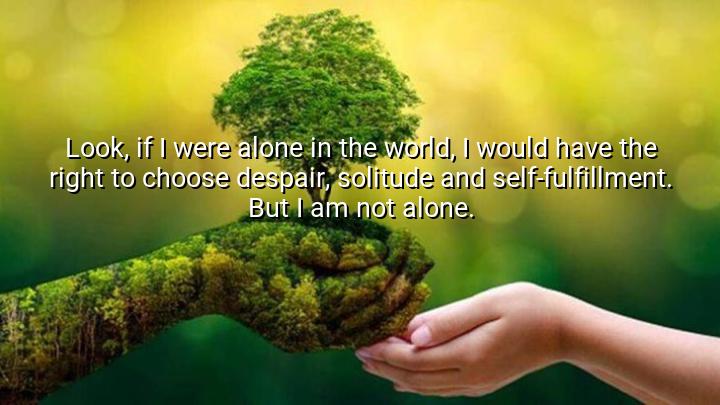




The quote "Look, if I were alone in the world, I would have the right to choose despair, solitude and self-fulfillment. But I am not alone" is from Elie Wiesel, a Holocaust survivor, writer, and Nobel laureate. Wiesel is best known for his work on the themes of suffering, memory, and humanity, particularly in his famous memoir Night. In this statement, he reflects on the personal freedom that solitude may offer, but also the responsibility that comes with being part of a larger community and humanity.
Wiesel begins by suggesting that in complete solitude, an individual could choose despair, retreating into personal grief or self-fulfillment without any obligation to others. The idea of being alone in the world provides the autonomy to embrace negative feelings like despair, as there would be no one else to affect or influence. However, Wiesel quickly shifts this notion by stating "But I am not alone", which signifies that human connection and the existence of others prevent him from choosing despair or withdrawing into isolation.
This statement highlights the responsibility we all have to others. Wiesel implies that the shared human experience requires us to think beyond ourselves and take into account the needs and well-being of others. He recognizes that his actions and choices, shaped by his experiences, have implications beyond his own personal fulfillment, especially in the context of community and human connection.
In essence, Wiesel’s quote underscores the conflict between individualism and the moral obligation we have toward others. It calls for a sense of responsibility in the way we live our lives, emphasizing that our solitude does not absolve us from engaging with and contributing to the greater collective. The quote reflects Wiesel’s broader themes of solidarity, empathy, and shared humanity, urging individuals to choose compassion over isolation.

ADViet Anh Do
Reading this makes me feel a quiet kind of sorrow. There’s a profound humility in acknowledging that one’s emotions—no matter how justified—are part of a larger ecosystem. It’s almost like a spiritual appeal to community. Do we owe our strength to others even when we’re broken? And if so, how do we cultivate that strength without ignoring our own suffering? It’s a hard truth to live by.
HNH Ngoc
This quote resonates deeply. It evokes the tension many of us feel between isolation and obligation. But what if someone’s ‘despair’ is invisible to others—does the world still have a claim on them? I wonder if this is also a call for empathy: a way of saying, 'I hurt, but I know you might too, and that matters.' Could this perspective help prevent the growing loneliness we see today?
TDThuy duong
Can individual freedom ever be absolute if we live in a world with others? I feel like this quote challenges the very idea of personal autonomy by introducing the moral claim of interconnectedness. But where do we draw the line between self-care and self-sacrifice? At what point does being responsible for others become self-neglect? It’s a troubling balance, especially for those prone to empathy.
SYHui Simp yanfei
I’m curious about the emotional weight behind this statement. It feels like someone who has suffered greatly but still acknowledges an unshakable bond to humanity. Is this rooted in guilt, love, duty, or perhaps all three? How do we decide when our own pain should take a back seat to the needs of those around us—especially if we feel we have nothing left to give?
TVphan thai van
This quote makes me wonder: To what extent are we ethically responsible for others' emotional or existential states? If I choose despair, does it harm others simply by my withdrawal from the shared human experience? I’m struck by the implicit tension between personal liberty and social responsibility here. Is it ever truly acceptable to prioritize one’s inner journey at the cost of collective well-being, or does connection always come first?