

Wherever men and women are persecuted because of their race, religion, or political views, that place must - at that moment - become the center of the universe.
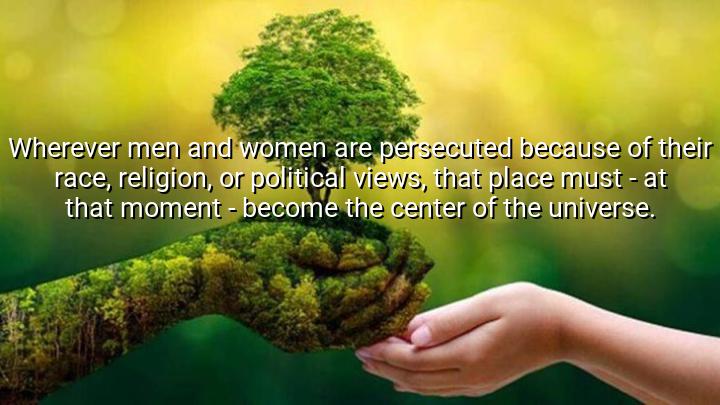




The quote by Elie Wiesel underscores the urgent moral responsibility to address persecution wherever it occurs. By stating that "that place must become the center of the universe," Wiesel emphasizes that the suffering of those who are persecuted for their race, religion, or political views should be our collective focus. It is a call for awareness and action, urging individuals and societies to prioritize the plight of the oppressed, regardless of geographical boundaries.
Elie Wiesel, a Holocaust survivor and Nobel laureate, witnessed firsthand the horrors of genocide and the dehumanization of individuals based on their identity. His experiences as a Jewish teenager in the Auschwitz and Buchenwald concentration camps profoundly shaped his belief in human rights and social justice. This quote reflects his lifelong advocacy for those suffering in silence, and his understanding that persecution cannot be ignored or minimized.
The origin of this quote can be traced to Wiesel’s belief that injustice anywhere threatens humanity as a whole. In moments of crisis, the world’s attention should shift to the places where human rights are under attack, regardless of political or social distance. Wiesel’s words challenge us to not be passive or indifferent but to recognize that the struggle for freedom and dignity is universal, and it requires our constant vigilance and action.
In sum, Wiesel's quote is both a moral imperative and a call to action. It demands that we direct our energies toward defending those whose voices are silenced by the forces of intolerance, discrimination, and violence, making their cause the focus of global attention and compassion.

AAdministratorAdministrator
Welcome, honored guests. Please leave a comment, we will respond soon