

Loneliness expresses the pain of being alone and solitude expresses the glory of being alone.
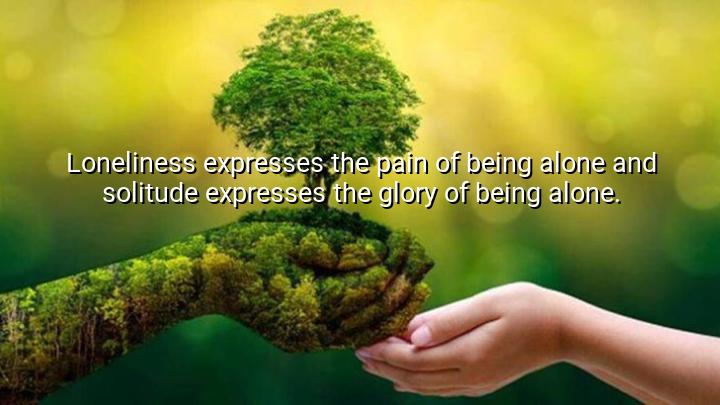




The quote "Loneliness expresses the pain of being alone and solitude expresses the glory of being alone" by Paul Tillich draws a significant distinction between loneliness and solitude. Tillich suggests that loneliness is the negative and painful experience of being alone, often accompanied by sadness, isolation, or emptiness. In contrast, solitude is portrayed as a positive and empowering state, where being alone brings a sense of peace, reflection, and even spiritual fulfillment. The quote reflects the idea that our emotional response to being alone can vary greatly depending on our mindset and perspective.
Paul Tillich, a German-American theologian and philosopher, is known for his work on existentialism and the relationship between faith and the human experience. Tillich often explored the tension between human anxiety and the search for meaning. His distinction between loneliness and solitude highlights a key theme in his work: the idea that isolation can either be a source of suffering or a pathway to personal growth and spiritual enlightenment, depending on how one approaches it.
The word "loneliness" in the quote emphasizes the emotional pain that comes with being disconnected from others, often stemming from a lack of meaningful relationships. This kind of loneliness can feel like despair or emptiness, making it difficult to find purpose or meaning. On the other hand, "solitude" is presented as a form of self-imposed and chosen isolation where one can explore personal identity, engage in creative or spiritual work, or simply enjoy being with oneself without the pressures of social demands.
Ultimately, Tillich’s quote invites us to reflect on the nature of being alone and challenges us to redefine it. It encourages us to recognize that while loneliness can be painful, solitude can be a sacred and transformative space, providing an opportunity for self-discovery, creativity, and inner peace. Through this lens, Tillich shows that the experience of being alone can be shaped by our attitude and approach, with solitude offering a positive and enriching aspect to our lives.

HLHao Le
This quote feels like a meditation on emotional maturity. It suggests that solitude is a higher-order state of being that not everyone reaches. But does the shift from loneliness to solitude require external support, like therapy or spiritual guidance? Or is it something a person can cultivate on their own? I’m fascinated by how language alone reshapes how we interpret the experience of being alone.
TTThao Thu
I love the distinction here—it feels philosophical and emotionally intelligent. But I wonder: is solitude a luxury that only certain people can afford to see as glorious? For those who are isolated not by choice but by circumstance—like the elderly, marginalized, or grieving—can it ever feel like anything but loneliness? This quote inspires me but also makes me question its limits in a broader societal context.
DDTran Duc Duy
This quote touches on something I’ve struggled with. How do you know when your solitude is actually beneficial versus when it’s become emotional avoidance? There’s a fine line between enjoying your own company and using it as a shield. Tillich seems to be advocating for an intentional and aware kind of aloneness—but is that always accessible to people dealing with trauma, grief, or depression?
TTDEP TRAI NHAT TOP TOP
Paul Tillich’s words make me reflect on how much our emotional state shapes our experience of being alone. The same physical situation—being by yourself—can feel vastly different depending on what’s going on inside. Is loneliness simply solitude without purpose or self-connection? Or is it more about feeling unseen? I’m curious if others think community is still necessary even for those who find glory in solitude.
NNNhan Nguyen
I find this quote deeply insightful, especially in an age of constant connection. It makes me question how often we avoid solitude because we fear it will become loneliness. Can solitude be learned or practiced like a skill? And how do we teach younger generations to embrace being alone as something enriching rather than isolating? I’d love to know if there are habits that make solitude feel more empowering.