

Language is a social art.
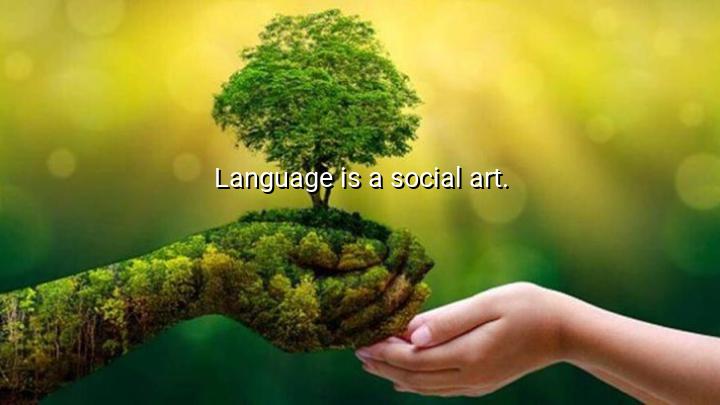




Willard Van Orman Quine’s quote, “Language is a social art,” reflects his belief that language is not a private invention but a shared human activity developed through social interaction. Quine, a prominent 20th-century philosopher and logician, emphasized that language is learned, understood, and shaped through communal experiences, rather than existing as a fixed or purely individual system. In this view, language functions as a tool for communication that evolves within social contexts.
Quine introduced this idea in his philosophical work, particularly in Word and Object (1960), where he explored how humans acquire meaning and interpret language. The phrase “social art” highlights that language is both creative and collaborative. Like art, it requires interpretation, negotiation, and shared understanding. People must agree, implicitly or explicitly, on the meanings of words and rules of grammar for language to function effectively.
By calling language an “art,” Quine also points to its flexibility, ambiguity, and expressiveness. Language is not a rigid, mechanical system but one that adapts, changes, and reflects the cultures and communities that use it. This contrasts with the view of language as a purely formal structure and instead sees it as a living process, shaped by social behavior and interaction.
Ultimately, Quine’s quote underscores the idea that understanding language requires us to understand human behavior and the social frameworks in which communication occurs. It reminds us that meaning is not static or absolute, but constructed and refined through our relationships, customs, and shared experiences—making language both a practical tool and a cultural achievement.

LLLinh Le
I love the elegance of this idea, but I also wonder—can language still be called a 'social art' when it's used to manipulate or deceive? Think about advertising, propaganda, or political spin. They all rely on social cues and artistic use of language, but for questionable purposes. Does that challenge the notion of art as something inherently good or enriching? Or does it just show the power of language's social function?
TTThanh Trung
This quote made me think about how children learn language—not through textbooks but through social engagement. Does this mean language acquisition is more of a communal process than an individual one? If so, how might that affect how we design education systems, especially in multilingual or multicultural societies? Should we focus more on group dialogue and less on rote memorization when teaching languages?
Kkiendeptraivodichcapvutru
What I find interesting here is the blend of structure and creativity. Calling language an art implies creativity, but it also has strict rules and grammar. So, how do we reconcile those two aspects? Is the artistry in how we bend the rules, create new words, or express subtle feelings? And who gets to decide what's 'correct' or 'beautiful' in a language that’s constantly shaped by social use?
TLTran Thi Thuy Linh
This quote immediately makes me think about how language shapes identity and community. If it’s a social art, then does every dialect or slang represent a unique cultural artwork? Should we be more protective of endangered languages and dialects, not just for heritage but for their artistic value? I’d love to hear how linguists or anthropologists interpret this quote in relation to language preservation efforts.
NT myhanh Nguyen T
Thinking about language as a social art makes me reflect on how much creativity and nuance go into even everyday conversations. It's not just about conveying information—it's about tone, rhythm, timing, and shared assumptions. Do you think this 'artistic' side of language is being lost in the digital age, where texting, voice notes, and emojis often replace face-to-face interaction? Are we evolving or simplifying our linguistic expression?