

Language... has created the word 'loneliness' to express the pain of being alone. And it has created the word 'solitude' to express the glory of being alone.
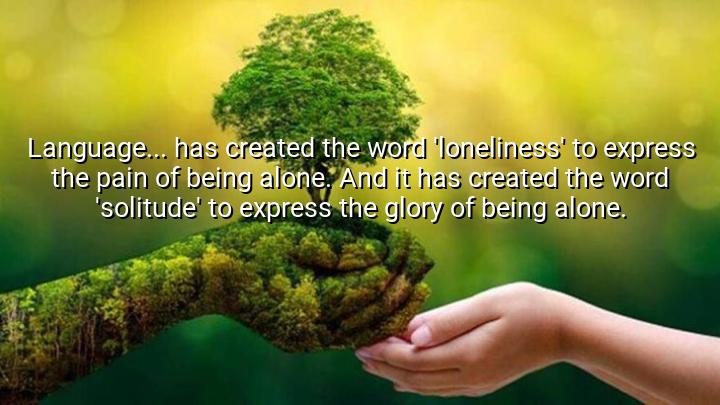




The quote "Language... has created the word 'loneliness' to express the pain of being alone. And it has created the word 'solitude' to express the glory of being alone" by Paul Tillich explores the dual nature of aloneness. Tillich differentiates between loneliness—which is typically associated with suffering, isolation, and a sense of being abandoned—and solitude, which can be a positive and empowering experience of peace, self-reflection, and personal growth. This distinction underscores the idea that being alone does not necessarily mean feeling lonely; it can also be an opportunity for connection with oneself.
Paul Tillich, a German-American theologian and philosopher, is known for his work in existentialism and the intersection of faith, psychology, and human existence. His teachings often dealt with themes of human anxiety, meaning, and the search for self. In this quote, Tillich highlights how language reflects the emotional complexity of being alone, and how words shape our understanding of such experiences.
The contrast between "loneliness" and "solitude" is essential in this quote. Loneliness typically carries a negative connotation, suggesting that one feels unwanted or disconnected from others. In contrast, solitude is seen as a voluntary and purposeful state, offering an opportunity to focus on personal growth, creativity, or spirituality. Tillich encourages us to reconsider our perception of aloneness and recognize that solitude can be a source of strength and clarity.
Ultimately, this quote is an invitation to rethink how we interpret solitude. While loneliness can feel isolating and painful, solitude can offer a rich and fulfilling experience. Tillich reminds us that, through language, we can reframe our understanding of being alone and learn to embrace it as a chance to connect deeply with ourselves, finding meaning and growth in the process.

PPPhuong plus
Tillich’s quote makes me think about the importance of language in shaping consciousness. If we didn’t have separate words for loneliness and solitude, would we still feel them as distinct experiences? Or would everything alone-related be lumped into a single emotional category? This really highlights how language can give us the tools to not only describe life but to interpret it with greater nuance.
NNNhat Nguyen
I find it fascinating how one experience — being alone — can produce such radically different emotions. This quote suggests that the words we use help us make sense of those emotions. But does labeling it as ‘loneliness’ or ‘solitude’ change the experience itself? I’d love to know if consciously redefining a moment alone as solitude could help ease the pain of loneliness.
-125. Bui Tran Thao Nhi - 11A1
This quote raises an interesting philosophical question — is solitude something we grow into, while loneliness is something we react to? Maybe solitude requires inner strength or emotional maturity to truly appreciate. I wonder if people who fear being alone haven’t had the opportunity to experience solitude in its most beautiful form. Could it be that learning to love solitude is one of the keys to emotional freedom?
VVVo Tram Phuong Vy Vo
This quote really struck me because I’ve felt both sides of that coin. Sometimes being alone feels peaceful and empowering, and other times it feels unbearable. What determines the shift? Is it about control — whether we choose to be alone or it’s forced on us? I think Tillich is onto something profound here about the power of perception and intentionality in shaping emotional experiences.
AT30 Tran Anh Tuan
I love the way this quote uses language itself to frame the emotional spectrum of aloneness. It makes me wonder — do other languages and cultures have the same distinction? Maybe the way we name experiences shapes how we feel them. I’d be curious to explore how solitude and loneliness are perceived in different parts of the world. Does everyone see solitude as glorious?