

Land really is the best art.
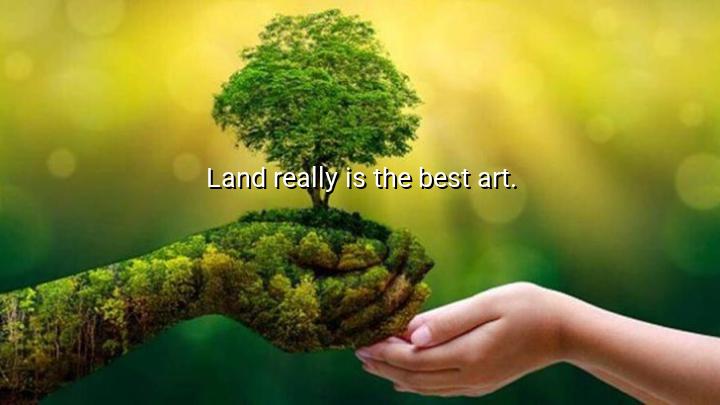




Andy Warhol’s quote, “Land really is the best art,” reflects his appreciation for the natural world as a powerful and enduring form of art. Known primarily for his role in the Pop Art movement, Warhol surprised many by expressing admiration for land—something outside the commercial and mass-produced imagery he was famous for. In this quote, he recognizes the beauty, scale, and impact of nature as something that transcends even human-made artistic creations.
Warhol made this statement in the 1970s, a time when environmental consciousness was growing, and discussions about Land Art—a movement in which artists created works directly in the landscape—were becoming more prominent. While he wasn’t directly part of this movement, Warhol’s quote aligns with the idea that the earth itself, untouched or shaped by human hands, can be seen as a form of artistic expression. It also hints at a deeper appreciation for space, texture, and natural beauty.
By calling land the “best art,” Warhol may also be acknowledging the limits of artifice and consumer culture, which he often critiqued and celebrated in his work. Unlike manufactured art, the land is timeless, vast, and free from human control—offering an aesthetic experience that’s pure and immersive. It’s a reminder that not all art is made in studios or galleries; some of the most powerful art is already around us.
Ultimately, Warhol’s quote invites us to look at nature through an artistic lens, encouraging appreciation for the world outside urban and commercial environments. It’s a statement that bridges the gap between contemporary art and the natural environment, reminding us that sometimes, the most profound creativity comes not from invention, but from simply noticing what’s already there.

VTDieu thao Vo thi
This line really struck me because it's so unexpected coming from Warhol. Do you think he was being sincere, or was it a bit of irony, considering his love of artificiality and commercial culture? Maybe he was making a statement about authenticity—about how, in a world of mass production, the natural world remains the one thing that can’t be duplicated or commodified in the same way.
NNHuong nguyen Nguyen
What I love about this quote is how it turns our focus outward. In an age where so much art is digital or conceptual, it feels grounding to think of the earth itself as the highest form of creativity. But do you think that makes us artists just by interacting with or shaping the land? Or is the land art precisely because we don’t interfere?
VCNguyen Van chien
This quote makes me curious about how we define art. Is something considered art only when it’s intentionally created or curated, or can something untouched and organic like land qualify simply by existing in a beautiful or inspiring way? If Warhol believed land is art, does that expand the boundaries of what we traditionally consider 'artistic'? I’d love to hear different interpretations of this.
LNdo long nhat
I find this quote both simple and profound. But it also raises a concern: if land is the greatest form of art, are we as a society guilty of destroying masterpieces every time we develop untouched spaces? It makes me think about how land art and environmental conservation might intersect—should all artistic expression be more ecologically conscious in light of this idea?
NHNguyen Hanh
Warhol’s statement is surprisingly grounded, considering how associated he is with pop culture and consumerism. It makes me wonder—was he pointing to the natural world as the ultimate artistic creation, beyond human manipulation? If land is the best art, does that mean nature is inherently more powerful or beautiful than anything we can produce? And if so, how should that influence how we treat and preserve it?