

It is the supreme art of the teacher to awaken joy in creative expression and knowledge.
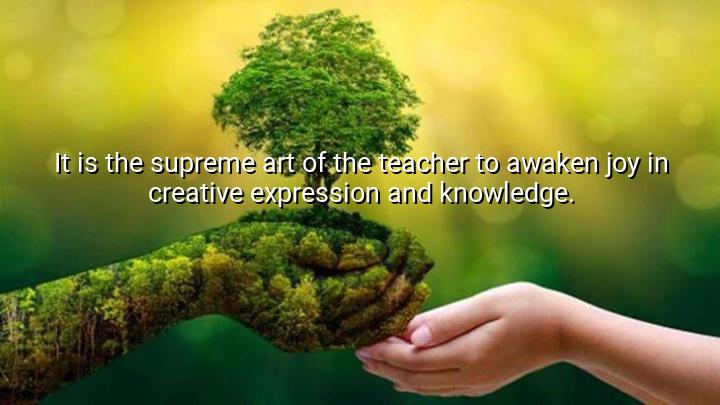




In this quote, Albert Einstein emphasizes that the true art of teaching is not just about imparting knowledge, but about awakening a sense of joy and creativity in students. He suggests that a great teacher has the ability to inspire and cultivate an enthusiasm for learning, making it an enjoyable and dynamic experience. Rather than simply delivering information, the teacher’s role is to encourage students to engage with the material in a way that sparks their imagination and fosters a love for creative expression.
The origin of the quote reflects Einstein’s deep respect for education and his belief that learning should go beyond rote memorization. As a scientist and theorist, Einstein understood that knowledge is not truly understood unless it is actively engaged with and internalized. He believed that the most effective education involves stimulating curiosity and excitement, allowing students to approach learning as a joyful and personal journey rather than a chore or obligation.
Einstein’s idea that the teacher’s supreme art is to awaken joy suggests that education is a transformative process that shapes not only the intellect but also the emotional and creative aspects of a person. This aligns with his belief that true learning happens when students are motivated to explore, experiment, and think critically. By focusing on creativity and joy, a teacher can foster a learning environment where students feel empowered to ask questions, take risks, and develop their own ideas.
Ultimately, this quote underscores the importance of passion and engagement in the classroom. Einstein’s view suggests that the greatest teachers are those who inspire students to find joy in learning, helping them to connect with the material on a deeper level. By awakening creativity and curiosity, these teachers help students become lifelong learners who are not just knowledgeable, but also passionate and imaginative thinkers.

GDGold D.dragon
This quote is incredibly idealistic, and I admire that. But I’m curious—how do teachers balance the pressure of measurable academic success with the more abstract goal of awakening joy? It sounds poetic, but in real classrooms, filled with diverse needs and limited time, how realistic is this vision? I’d love to hear from teachers themselves about whether this is something they actively aim for or if it remains more aspirational.
NHNguyen Thi Nguyet Hong
Einstein's take here resonates deeply, especially when thinking about early childhood education. Kids are naturally creative and curious, yet somewhere along the way, many lose that spark. Why does our system so often extinguish rather than ignite this joy? Could it be that our focus on standardized education inherently stifles creative expression? What would a system look like if it prioritized emotional engagement and intellectual wonder above all else?
TBVu thanh Bui
This quote makes me appreciate the truly exceptional teachers I’ve had—those who made learning feel like a personal adventure rather than a chore. But how does one teach a teacher to become this kind of guide? Is this 'art' something that can be trained, or is it more about a natural gift? I’d love to know how teacher training programs today incorporate creativity and emotional intelligence into their curricula.
Dduongdz
I love this idea, but it also raises a concern for me: what happens to students who never encounter a teacher capable of this 'supreme art'? Is their potential for joy in learning diminished forever, or can that spark still be found later in life? I’d be interested to hear how informal mentors, online educators, or even peers might step into this role when traditional teachers fall short.
TTLinh Nguyen Thi Thuy
Einstein’s perspective on teaching really makes me reflect on how rare it is to find educators who inspire genuine curiosity. I wonder, in today’s rigid educational systems focused on testing and outcomes, is there still room for that kind of joyful, creative awakening? Are teachers even empowered to focus on this ideal, or are they too burdened by administrative and curricular constraints to make space for such inspiration in the classroom?