

Insight is the first condition of Art.
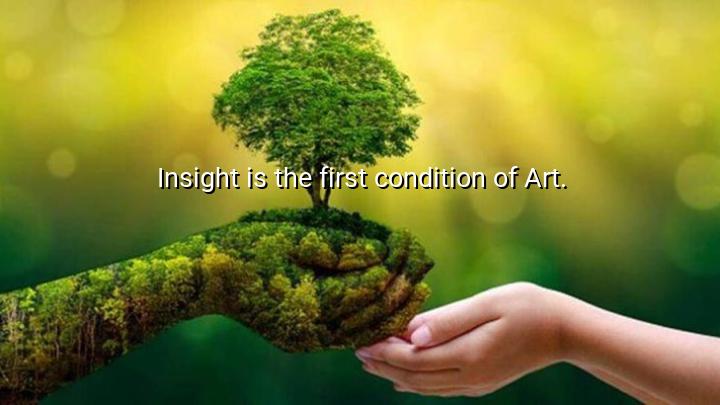




In this quote, George Henry Lewes suggests that insight is the essential starting point for creating art. He argues that to truly create something meaningful, an artist must first have a deep understanding or perception of the world around them. Insight is not just about seeing things at surface level; it involves a more profound awareness of human emotions, experiences, and the complexities of life. This perception becomes the foundation upon which an artist can build their creative expression.
The origin of the quote comes from Lewes' work as a philosopher and critic, who was deeply interested in the nature of human consciousness and artistic creation. As a thinker, Lewes believed that art is not just about technical skill or aesthetic beauty but about the ability to reflect on and interpret the deeper truths of life. His focus on insight aligns with the idea that great art requires more than just talent; it demands a keen awareness of the world and a unique perspective.
Lewes' view also suggests that art is a form of communication that transcends the superficial. Insight allows the artist to express something universal that resonates with the audience on an emotional or intellectual level. It is through this understanding that an artist can capture the essence of life and convey it in a way that is both relatable and profound, offering the viewer a new perspective on the world.
Ultimately, the quote emphasizes the importance of awareness and reflection in the artistic process. Without insight, art would lack depth and meaning. Lewes’ statement invites us to appreciate the intellectual and emotional work that underpins great art, highlighting that true artistic creation begins with a deep understanding of the human experience.

TMThanh Mai
This makes me think about the role of the viewer. If insight is foundational to art, does the responsibility lie with the artist to convey that insight clearly, or with the viewer to discover it? What happens when the audience doesn’t see the insight intended by the creator? Is the work then a failure, or is the insight still there, regardless of perception? It raises questions about the shared ownership of meaning in art.
KVLe Khanh Vy
So if insight is the 'first condition,' does that mean everything else—technique, medium, originality—comes second? I’d love to unpack that hierarchy. Can a poorly executed piece still be considered great if it’s rich in insight? And how do we measure or validate insight in art anyway? Is it enough that the artist believes they’ve captured something meaningful, or must the audience perceive it too?
HMTRUNG HO MINH
I'm intrigued by the philosophical depth here. Does this quote reflect a more elitist view of art? It seems to suggest that only those with a certain level of intellectual or emotional awareness can create real art. But what about art that’s born from chaos, randomness, or even naïveté? Could this perspective unintentionally exclude outsider or folk artists who may lack formal insight but express something profoundly human?
GHVu Gia Huy
Is George Henry Lewes suggesting that the artist must possess insight before the act of creation, or can the insight emerge during the process itself? As someone who creates in bursts of inspiration, I sometimes find meaning only after the fact. I’m left wondering if retrospective discovery can still be considered valid insight under this view. What do you think—is insight a prerequisite, or can it be a byproduct of artistic exploration?
LNLinh Nguyen
I find this quote incredibly thought-provoking. It makes me wonder: what exactly qualifies as 'insight' in the context of art? Is it a deep understanding of the human condition, a novel perspective, or something else entirely? And does this mean that technically brilliant works that lack deeper meaning fall short of being true art? I'd love to hear how others define insight in this creative context.