

In art, the hand can never execute anything higher than the heart can imagine.
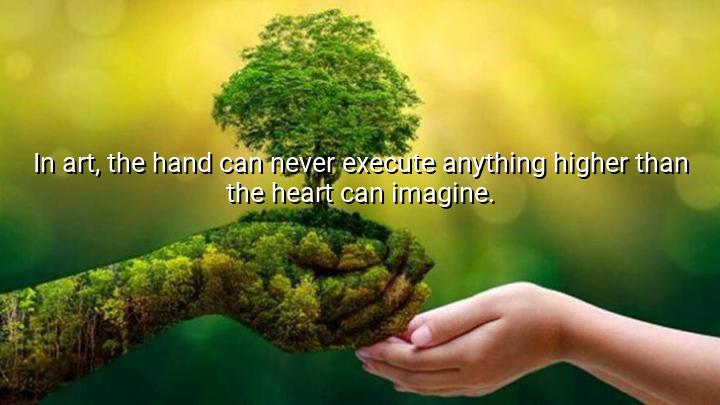




The quote "In art, the hand can never execute anything higher than the heart can imagine" by Ralph Waldo Emerson speaks to the deep connection between an artist's inner vision and their ability to express that vision through their craft. Emerson suggests that the hand, which represents the physical act of creating, is limited by the capacity of the heart or the artist's imagination. In other words, an artist can only bring to life what they are able to conceptualize and feel deeply. If the heart is not inspired or lacks vision, the work created by the hand will be constrained and unable to reach its full potential.
Emerson’s quote emphasizes the importance of the imagination and the emotional drive behind creation. The heart, in this context, represents the source of inspiration, passion, and vision. Without a rich inner life, an artist may find it difficult to produce meaningful or innovative work. The hand, on the other hand, is the tool through which these internal emotions and ideas are made tangible, but it is ultimately bound by what the artist can imagine or feel. This idea aligns with Emerson’s broader belief in the power of the individual’s mind and spirit to shape the world.
This statement also suggests that technical skill, while important, is secondary to emotional and conceptual depth. The artist’s technical ability to handle materials and tools (the hand) is crucial, but it can only go as far as the emotional and intellectual foundation laid by the heart. Art is not just a matter of executing techniques but is about translating inner thoughts, feelings, and experiences into forms that resonate with others. The greatest works of art, therefore, are those that come from a deep, imaginative, and emotional place.
Ultimately, Emerson’s quote reinforces the idea that art is a reflection of the artist’s soul and vision. The heart provides the spark, the idea, and the emotion, while the hand is the means of bringing those elements to life. True artistic achievement, according to Emerson, depends on the harmony between the two, where the artist's inner world aligns with their ability to execute it in the physical realm.

KNKhanh Nguyen
This quote really affirms the importance of inner vision in any creative endeavor. I’m drawn to the idea that imagination is the ceiling and our hands can only ever try to catch up. But it also makes me wonder: how do we grow the imagination itself? Is it just a matter of emotion and introspection, or does exposure to other art and experiences help expand what the heart can conceive?
HHinh
Emerson’s words feel like both a truth and a challenge. I’ve often had creative ideas that felt emotionally profound, but when I tried to execute them, they fell short. Does that mean the heart was too ambitious, or the hand too untrained? How do we reconcile the desire to express our innermost selves with the reality of our current skill level? Can that very struggle be part of what makes the art meaningful?
NMNguyen Minh
This quote makes me reflect on the relationship between feeling and form. It suggests that art begins long before the first brushstroke, and that imagination—not technique—is the highest artistic force. Do you think this implies that art created without genuine emotional engagement lacks soul, no matter how technically skilled it is? It raises the question of whether audiences connect more with what they see or with the invisible passion behind it.
TDTuong Dy
I find this quote incredibly inspiring but also slightly intimidating. If the heart is the ultimate source of artistic greatness, does that mean technical mastery is always secondary? And how do we cultivate imagination that’s worthy of expression? I’m curious whether emotional intelligence and life experience play a bigger role in creating powerful art than years of practice. Can someone with little training but a rich emotional world still make something transcendent?
THnguyen thu hang
This quote resonates with me deeply—it feels like a reminder that emotional depth is the true foundation of meaningful art. But it also makes me wonder: what happens when an artist’s technical skills haven’t caught up with their inner vision? Is there a gap between what we feel and what we can express? I’d love to hear how others bridge that space between emotional intention and physical execution in their creative work.