

If we could but paint with the hand what we see with the eye.
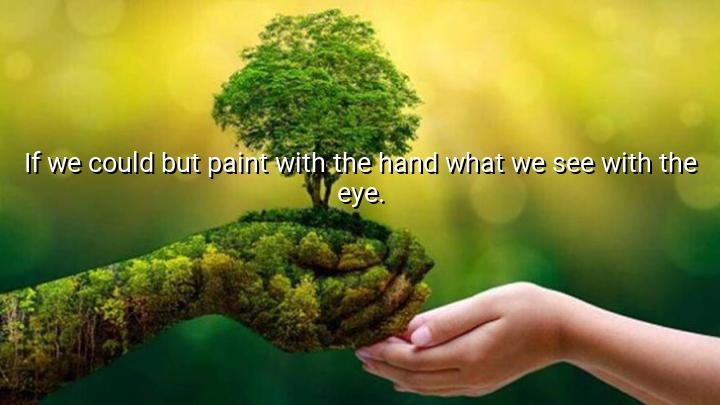




The quote "If we could but paint with the hand what we see with the eye" by Honoré de Balzac expresses the frustration of not being able to perfectly translate what we perceive visually into artistic form. Balzac is highlighting the gap between the reality of what we observe and the limitations of the tools we use to represent that reality. The eye captures details, colors, and depth, but the hand struggles to convey them with the same richness and accuracy.
Balzac, a French novelist and playwright, often delved into the complexities of human experience and expression. Through this quote, he suggests that the act of creation—whether in painting or any other art form—always involves some form of imperfection, as no artist can fully capture the nuances of their visual experience. The artist is limited by their medium, and there is always a disparity between the idealized vision in their mind and the physical manifestation on canvas or paper.
The origin of this quote reflects Balzac's deep understanding of the challenges of artistic expression. He was well aware of the difficulties artists face in translating their mental images into tangible creations. This frustration of artistic limitation is a theme that appears not only in visual art but in all forms of creativity, where the mind often envisions more than the hand can produce.
For artists, this quote serves as both a reflection on the limitations of their craft and an invitation to embrace the imperfect nature of art. While we may never be able to fully replicate what we see with our eyes, the process of creation remains valuable as it allows for a personal interpretation of the world. Balzac's words remind artists that even with these limitations, art holds immense value in capturing the essence of what we experience.

PLTran Phuong Linh
This quote reminds me of how children draw—with so much intention, but often without the motor skills to match what they imagine. It’s not just about vision or talent, but about the disconnect between perception and physical execution. How much of artistic development is really about closing that gap? I’m curious whether artists eventually learn to bridge it or if they just become better at translating emotion rather than form.
DMVu Duc Minh
There’s a bittersweet truth here. It makes me wonder if part of the magic of art is in its failure to be exact. If we could effortlessly recreate everything we see, would that eliminate the mystery, the emotion, the interpretation? Maybe it’s the struggle itself—the imperfection—that makes art human and moving. Could it be that our inability to perfectly replicate what we see is actually what gives art its soul?
MNMinh Na
Balzac’s thought makes me question the limits of human expression. If we can’t fully translate visual perception into artistic output, what else are we failing to communicate? Does this limitation exist in all forms of expression—writing, music, even conversation? Maybe this is why great art feels so rare: it somehow bypasses that barrier and hits closer to what the artist actually saw or felt. But how do we even measure that kind of success?
NTNguyen Truc
I find this statement almost heartbreaking. It makes me think of all the moments of beauty that pass by unrecorded—not because they aren’t seen, but because they can’t be fully captured. Do we lose something essential when trying to replicate visual experiences through art? Or does the act of trying add something new? Maybe art isn’t just about copying what we see, but about interpreting and reimagining it.
GDGold D.dragon
This quote really resonates with me as someone who’s dabbled in drawing. There’s always this frustrating gap between what I envision and what my hand can actually produce. Is Balzac saying that technical skill is the main barrier, or is it deeper—something about the mind’s eye perceiving more than physical tools can translate? I wonder if any artist, even the greats, has ever truly captured what they saw in its entirety.