

If only life could be a little more tender and art a little more robust.
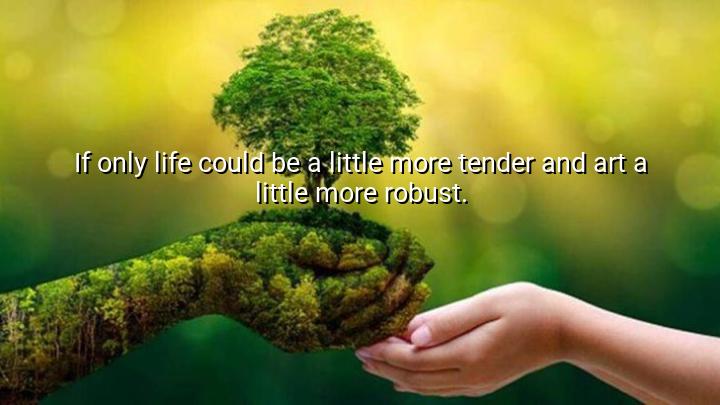




The quote "If only life could be a little more tender and art a little more robust" by Alan Rickman reflects the actor's desire for a balance between the softness of life and the strength of art. Rickman, known for his deep, nuanced portrayals in both film and theater, often explored complex emotions and the contrasts between tenderness and strength in his work. In this quote, he expresses a longing for life to be more gentle and compassionate, allowing for vulnerability and softness, while wishing that art could be more forceful and enduring, capable of creating lasting impact.
By describing life as something that could benefit from being "a little more tender," Rickman points to the emotional and human qualities of care, gentleness, and empathy that we sometimes lack in our daily interactions. The world can often feel harsh and unforgiving, so a more tender existence would offer comfort and healing, allowing people to embrace compassion and understanding more fully.
On the other hand, Rickman contrasts this with his hope that art could be "a little more robust." In this context, robust refers to the resilience, boldness, and enduring power of art—qualities that allow it to transcend time, challenge boundaries, and provoke thought. By wishing for art to be more robust, Rickman envisions a world where creativity is stronger and more impactful, not just fragile or easily overlooked.
In essence, Rickman’s quote speaks to the delicate balance between the vulnerability of life and the strength of art. It suggests that while life often lacks the softness and care it needs, art could become a more powerful force if it were more enduring and influential. This juxtaposition invites reflection on the ways in which we approach both our emotional experiences and the way we engage with creative expression.

YNNguyen Thi Yen Nhi
This quote breaks my heart a little. It feels like a gentle wish for a world that both hurts less and expresses more. But I’m curious—what role does society play in shaping this dynamic? If we created more compassionate communities, would art naturally grow bolder? Or is it the other way around—does powerful, unfiltered art inspire people to treat each other with more tenderness?
PY30 Huynh Chau Phi Yen
Rickman’s quote left me reflecting on whether art and life are moving in opposite directions. Life seems to grow more chaotic, more anxious, and yet art, especially in mainstream spaces, often feels polished or hollow. Are we afraid of raw, gritty artistic honesty because it reflects too much of life’s harshness back at us? Or are we just craving something real, no matter how bold or beautiful?
WWuynh
I love the bittersweet nature of this thought. It reminds me of how often we expect art to heal us when life doesn’t. But what does it mean for art to be more 'robust'? Politically louder? Emotionally more daring? More truthful? And do we, as a society, truly make space for robust art—or do we censor and market it until it becomes another soft product?
TDThao Dang
This quote feels like a sigh from someone who has seen both the cruelty of the world and the fragility of artistic expression. But is it fair to ask for art to be 'robust'? Shouldn't art reflect vulnerability too? And maybe life’s lack of tenderness is exactly what fuels some of the greatest, most moving works. Is there a risk that by making art 'tougher,' we lose its intimacy and nuance?
TTnguyen thanh thuan
I wonder if Rickman was reacting to a specific cultural shift—maybe how art can feel overly sanitized now, or how people are becoming desensitized to emotional vulnerability in real life. It makes me think about whether modern art avoids risk and boldness in favor of safety. What kind of world are we shaping when we dull our creative edges and forget to nurture kindness in daily living?