

I think having land and not ruining it is the most beautiful art that anybody could ever want to own.
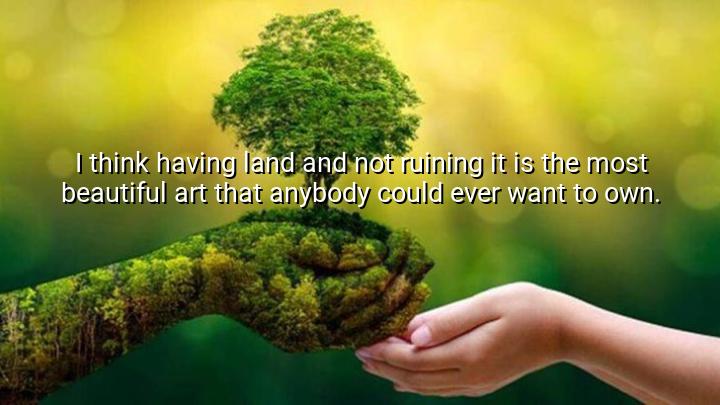




Andy Warhol’s quote, "I think having land and not ruining it is the most beautiful art that anybody could ever want to own," presents an unconventional view of art and ownership. Warhol, known for his avant-garde approach to art and his focus on mass production and consumer culture, here suggests that the true form of art is not found in traditional creative expressions like painting or sculpture, but in the responsible stewardship of the land. For Warhol, preserving the natural beauty of the earth becomes the highest form of creativity.
The phrase "not ruining it" speaks to the importance of sustainability and respect for the environment. Warhol implies that maintaining the integrity of the land is an artistic act in itself, requiring care and mindfulness. By contrasting this idea with the idea of ownership, he highlights the notion that true possession comes not from exploitation but from preservation, suggesting that the art of environmental responsibility is far more valuable than any material object one could own.
Warhol’s perspective is likely influenced by his awareness of the impact of industrialization and mass production on the environment. As an artist who often explored themes of consumerism and mass culture, he might have seen the degradation of nature as a reflection of the ways in which society consumes and disregards resources. His quote invites a rethinking of what it means to own something, suggesting that true ownership is not about control or accumulation but about nurturing and protecting the world around us.
Ultimately, the quote encourages a shift in the way we view ownership and art, urging us to recognize the profound beauty in caring for the earth. In Warhol’s eyes, the most beautiful art is not something displayed in galleries, but something we live with and maintain—our relationship with the land itself.

TTrongThanh
I really resonate with the idea that 'not ruining' something can be beautiful. But it also makes me question: is that enough? With so much ecological damage already done, can simply preserving land still count as art, or do we need to actively restore and reimagine our relationship with nature? What’s the line between passive appreciation and meaningful action? Warhol’s quote is lovely, but it also leaves me wanting a clearer sense of direction.
HGLe thi Huong Giang
This quote made me think of how rare it is to see land as something sacred and complete in itself. Do you think the average landowner feels that way? Or has land become more of a status symbol or investment than a space to be honored? I wonder what kind of cultural shifts would need to happen for more people to view environmental stewardship as a form of art rather than just responsibility.
PVLE PHUC VINH
There’s something really humbling about this quote. It suggests that the highest form of art might be choosing *not* to leave a mark. In a world obsessed with innovation and impact, that's a pretty radical idea. Could this be a critique of modern art or architecture that imposes itself on nature? What would our landscapes look like if more creators considered restraint as a creative act rather than a limitation?
TTNguyen Thanh Tung
Honestly, I didn’t expect this kind of sentiment from Andy Warhol. He’s usually associated with mass production and consumer culture, so this reverence for nature feels almost contradictory. Do you think he meant it literally, or was he making a commentary on ownership and aesthetics in a more abstract way? Either way, it raises a good question: what kind of legacy are we leaving behind in the way we treat the land?
TAThuy Trang a5
I find this quote both inspiring and a little bittersweet. It implies that true beauty lies not in what we build or own, but in what we choose to preserve. It makes me wonder—how many people with access to land actually see it this way? Do you think modern society encourages people to value natural preservation, or does consumerism push us toward development over protection? What would change if more people shared Warhol’s perspective?