

I really do believe that art changes the landscape of the world.
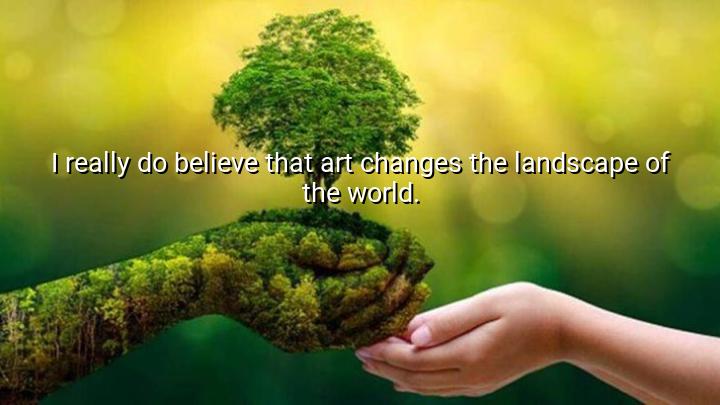




In this quote, Marc Jacobs, a prominent fashion designer, expresses his belief in the transformative power of art. He suggests that art has the ability to change the landscape of the world, not just physically but also in terms of culture, society, and human experience. This transformation can be both visible, in the form of architecture, fashion, or public art, and abstract, influencing how people think, feel, and interact with the world around them. For Jacobs, art plays a central role in shaping the future and direction of society.
Jacobs' statement highlights the impact that art has on culture and human progress. Art is not just a reflection of the world; it actively contributes to the evolution of social and cultural movements. It can challenge conventions, raise awareness about issues, and inspire new ways of thinking. Whether through fashion, music, literature, or other forms, art helps to reshape societal norms and provides a platform for expression and innovation.
The idea that art changes the landscape of the world also implies that it has a lasting influence. Art, in all its forms, can leave a legacy that outlasts the creator, impacting future generations and shaping collective identity. It moves beyond the moment of creation to inspire change, encourage reflection, and sometimes provoke action. Through its ability to communicate across time and cultures, art becomes a catalyst for growth and social evolution.
Ultimately, Jacobs’ quote speaks to the power of art to challenge, influence, and inspire change. By recognizing art as a force that shapes the world, Jacobs highlights its central role in fostering new ideas, expanding perspectives, and contributing to the progress of humanity. Whether seen in the work of artists, designers, musicians, or thinkers, art has the potential to leave a profound mark on the world, altering its landscape both physically and culturally.

NNTran Le Nguyen Ngoc
There’s a certain optimism here that I really admire, but I also wonder about the darker side—can art also negatively influence the landscape? For example, propaganda or manipulative imagery has shaped societies too, often for the worse. So, is it accurate to say art ‘changes’ the world, or should we specify that it has the power to shape it for better or worse depending on intention and context?
HNPhan Thi Huong Nhi
I love this quote because it affirms the idea that creativity has real-world consequences. Think about how the feminist art movement, or protest songs from the 60s, reshaped societal conversations. Art doesn’t just sit in a gallery; it pulses through streets, ideas, and generations. That said, do you think today’s digital art world—where work is often consumed in seconds—has the same ability to leave a lasting mark?
NMQuan Nguyen Minh
I’m curious how people define ‘landscape’ in this context. Is Marc Jacobs referring to cultural attitudes, aesthetics, political thought, or actual physical spaces? Art undoubtedly influences all of these, but it’s such a broad idea. Can we explore more tangible examples of how art has changed landscapes—like Banksy’s political graffiti or the AIDS Memorial Quilt? I’d love to hear specific stories of art literally reshaping our surroundings.
HTPham Hoang Tam
It’s a beautiful and hopeful sentiment that art can change the world’s landscape. But sometimes I worry we romanticize art’s power without looking at the systemic barriers that limit its reach. For instance, in areas with little access to art education or funding, how much of this 'change' is even possible? Can we talk more about the infrastructure needed to make this transformative potential of art a reality for all communities?
VDnguyen Vinh Duy
This quote makes me think about how fashion, design, and visual art have changed the environments we live in—literally and metaphorically. Marc Jacobs, coming from the fashion world, must see firsthand how creative vision can redefine cultural norms. But does all art have that transformative potential, or is it only certain kinds that truly shift the 'landscape'? What separates meaningful impact from fleeting visual trends?