

I really believe there are things nobody would see if I didn't photograph them.
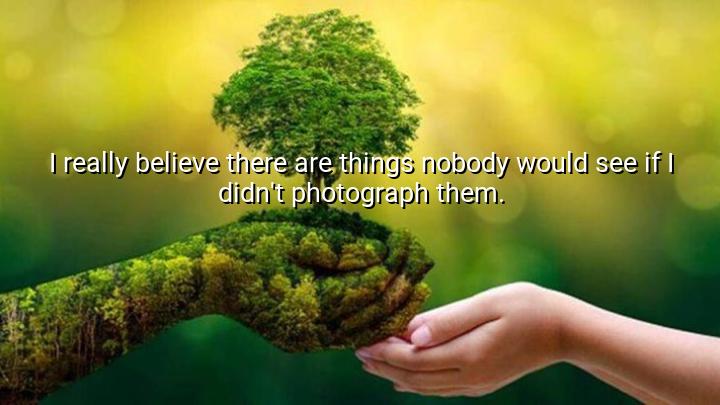




The quote "I really believe there are things nobody would see if I didn't photograph them" by Diane Arbus highlights the unique role of the photographer in revealing aspects of the world that might otherwise remain unnoticed. Arbus, a renowned American photographer known for her provocative and intimate portraits, suggests that through photography, she has the ability to capture moments, people, or scenes that are often overlooked or misunderstood. Photography, in this sense, becomes a tool for bringing attention to the hidden or marginalized aspects of life, forcing viewers to confront what they might otherwise ignore.
Arbus’s work often focused on unconventional subjects, such as individuals with physical disabilities, marginalized communities, and others who existed outside the mainstream of society. Her quote speaks to the power of art to reveal new perspectives and draw attention to the unseen. Through the lens of the camera, she was able to capture and immortalize subjects in ways that challenged societal norms and expectations, prompting viewers to reconsider their preconceived notions.
This quote also reflects the idea that photography is not just about documenting reality, but about shaping how we perceive and understand the world. A photographer like Arbus has the power to highlight aspects of life that might otherwise go unnoticed, making the invisible visible and challenging viewers to see the world from a different angle. The act of photographing becomes an act of interpretation and expression, rather than just simple recording.
Ultimately, Arbus’s statement underscores the transformative power of photography as a medium that can reveal deeper truths about humanity and society. Through her lens, she was able to showcase the beauty, complexity, and vulnerability of her subjects, reminding us that art has the ability to expose what is often hidden from view.

MATran Minh Anh
This quote speaks to the power of the photographer’s perspective, but it makes me question—are there things we can only see through an artist’s lens, or do we need to change our mindset to notice them ourselves? Are artists and photographers just showing us what we’ve been blind to, or are they reshaping our understanding of the world entirely? What does it mean to ‘see’ something that was previously invisible?
Nnhi
I love how Arbus seems to suggest that photography is not just about capturing a moment but revealing a hidden world. But does this idea raise the question of whether we’re truly seeing the ‘truth,’ or are we simply seeing what the photographer wants us to? How does the photographer’s subjectivity shape what we perceive as invisible or hidden? Can we truly separate the artist's vision from the reality they capture?
HDHoang hong duc
This quote by Arbus highlights the idea that photographers can bring awareness to the overlooked or ignored. I wonder, though, how much of this ‘unseen’ is cultural or contextual? Is what one photographer sees as overlooked really universal, or does it depend on the audience? Can we say that a photographer truly reveals something unseen, or is it more about bringing attention to what was always there but ignored?
HVHuyen Vu
I find Arbus’s quote thought-provoking, as it touches on the idea that art, particularly photography, has the power to highlight things we might overlook. But how much of what we see through a photograph is shaped by the artist’s intention versus our own interpretation? Does this mean that the reality captured in photos is subjective, shaped by the photographer’s personal view of the world?
E107.Le Kieu Duy Em 11a10
Arbus's belief is fascinating—how many things do we miss daily that are only captured through the eyes of an artist? It makes me wonder about the power of perspective. If an artist’s vision is to reveal hidden aspects of reality, does that mean our daily perception is limited? Can photography truly reveal things that are otherwise invisible to us, or is it just a different way of seeing the same world?