

I rarely draw what I see. I draw what I feel in my body.
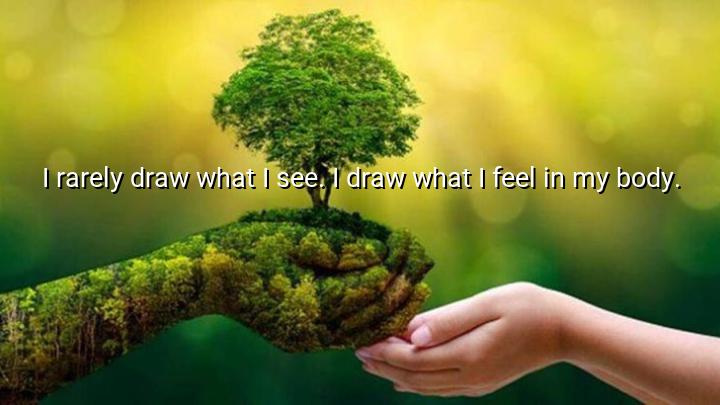




The quote "I rarely draw what I see. I draw what I feel in my body" by Barbara Hepworth speaks to the deeper, more emotional connection that an artist can have with their work. Hepworth, a British sculptor known for her abstract and organic forms, suggests that her creative process is driven not by direct visual observation, but by her inner emotional and physical sensations. Instead of merely replicating what is in front of her, she uses her feelings and bodily experiences as the foundation for her art.
This statement highlights the idea that art is not always about accurate representation or visual imitation. Hepworth’s focus on drawing what she feels rather than what she sees shows how personal and instinctual her approach to art was. It reflects the concept that art can be a translation of internal experiences, emotions, and sensations, rather than an external observation of the world. For Hepworth, creating art was a deeply introspective and sensory process, shaped by the rhythms and physicality of her own body.
By drawing from her body, Hepworth also connects her work to her physical existence, emphasizing the unity between mind, emotion, and physical form. This approach challenges traditional methods of representation, where the artist's focus is solely on the external world. Instead, Hepworth’s art conveys her inner state, allowing the viewer to experience not just what she sees, but what she feels. This focus on internal sensation invites a more visceral, emotional engagement with the work.
Ultimately, Hepworth’s quote underscores the importance of emotion and sensory experience in the creative process. It suggests that art can be a personal exploration of what it means to be human—one that connects the external world with the inner, often unspoken, emotions and sensations of the artist. Through this approach, Hepworth’s work transcended visual representation, offering a deeper, more intuitive understanding of the human experience.

UGUser Google
What Hepworth describes feels like a very intimate form of expression. If an artist draws based on physical sensations rather than visual reality, what does that mean for how we experience art? Is the work meant to be a reflection of the artist’s body, or does it serve to evoke similar feelings in the viewer? I’m curious whether this approach leads to more abstract or interpretative art forms.
BPTran Phan Bich Phung
I really resonate with this quote. The idea that drawing is a form of expressing inner sensations, rather than just reproducing reality, is powerful. But it does raise a question for me—how can artists ensure their emotional connection is transferred to the viewer effectively? Can the viewer truly 'feel' what the artist intends, or is it possible that the personal nature of the art limits its accessibility?
ZRDang Zo ram
Hepworth’s statement is fascinating because it suggests a completely different approach to art creation. I’ve always thought of drawing as a way to recreate what I see in front of me, but this idea of focusing on what you feel in your body changes that dynamic. Do you think it’s more challenging to communicate these bodily feelings to the audience? Is there a risk that viewers might not 'feel' what the artist intends?
KDNguyen khanh duy
I love the idea that Hepworth is focusing on what she feels rather than what she sees. It’s almost like art becomes a personal, bodily experience, rather than just a technical skill. But I wonder how this works when creating art for others to view—do artists risk making something so personal that it becomes unrelatable for the audience? Or is that emotional depth exactly what draws people in?
NLNguyen danh Ngoc lam
I find Hepworth’s perspective really intriguing because it shifts the focus from visual representation to emotional and bodily expression. It makes me wonder, how many artists feel that their physical sensations and emotions are more important to capture than what they literally see? How do you think this impacts the way viewers interpret the artwork, especially if they don't have the same personal connection to the subject?