

I like to learn. That's an art and a science.
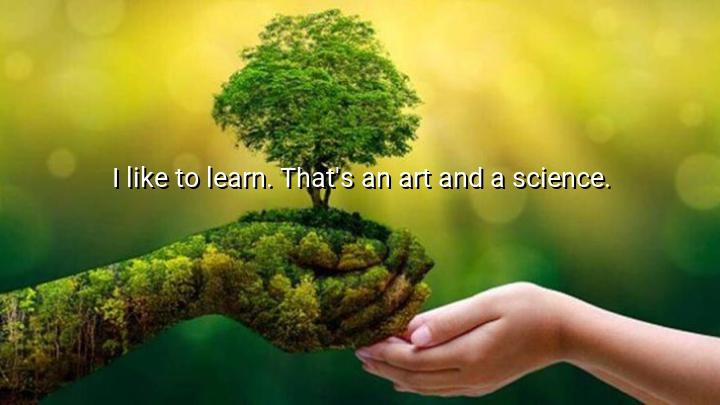




Katherine Johnson, a pioneering African-American mathematician and physicist, is known for her extraordinary contributions to NASA. The quote "I like to learn. That's an art and a science." reflects her lifelong passion for knowledge and discovery. In this statement, she emphasizes that learning is not just a simple process of absorbing information but a combination of both art and science.
The term art suggests creativity, intuition, and the ability to approach challenges in innovative ways. On the other hand, science represents structure, logic, and the systematic pursuit of understanding. By combining these two elements, Johnson recognized that learning involves both creative thinking and analytical reasoning, an approach that she applied throughout her career.
Johnson’s journey in the sciences, particularly in a field dominated by men and racial prejudice, required not only intelligence but also a creative approach to problem-solving. Her statement shows that learning is not merely about acquiring facts but about continuously evolving through art and science, constantly adapting to new challenges.

THNhi Ngo Thi Ha
What struck me most about this quote is the humility and enthusiasm behind it. Learning as both an art and science feels especially true in our fast-changing world. How do we stay open to lifelong learning without getting overwhelmed? I wonder what strategies Johnson used to keep learning joyful and purposeful, especially when working in high-pressure, high-stakes environments like NASA.
MT34.Nguyen Minh Tien-10A11
This quote is deceptively simple but incredibly deep. It reminds me that mastering the skill of learning itself might be more important than any single subject. Why don’t we teach more about 'how to learn' in schools? It feels like that meta-skill—the science of understanding, the art of curiosity—is the real secret to thriving in both academic and real-world situations.
LTLong Tran
I love how this quote blurs the line between art and science. It makes me think about the many ways learning takes shape—not just through formulas or facts but through creativity, interpretation, and emotion. Do we undervalue the emotional intelligence needed to be a great learner? Sometimes it feels like the most effective learners are the ones who can balance logic with empathy and open-mindedness.
SKSky Kin
Katherine Johnson’s perspective here is powerful, especially coming from a scientist who broke so many barriers. It raises a bigger question for me: is the ability to learn well something we’re born with, or something we can truly cultivate over time? And if it’s both, what can schools and communities do better to nourish that artistic and scientific side of learning for all types of students?
TDTuong Dy
I appreciate how this quote balances the rational and the creative aspects of learning. But it makes me ask—how often is the educational system too focused on the 'science' part and not enough on the 'art'? Learning isn’t always linear, and sometimes exploration and curiosity get lost in rigid curriculums. Should education shift more toward encouraging students to see learning as an evolving personal experience?