

I cry out for order and find it only in art.
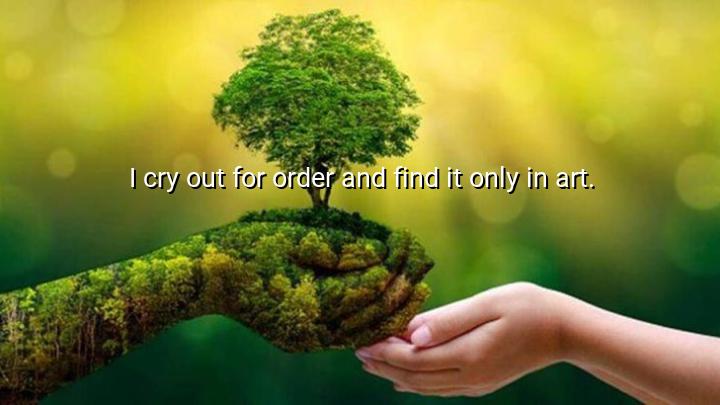




The quote "I cry out for order and find it only in art" by Helen Hayes speaks to the comforting and organizing power of art in a chaotic or uncertain world. Helen Hayes, a celebrated American actress, suggests that in the midst of personal or societal turmoil, art offers a sense of structure, clarity, and emotional refuge. While life may seem unpredictable and disordered, art provides a space where order can be found, allowing the individual to experience coherence and meaning through the creative process.
Hayes’s words reflect the idea that art has the ability to impose a sense of order on both the internal emotional landscape and the external world. Whether through theater, music, painting, or other artistic forms, art offers a structured environment where thoughts and feelings can be expressed in a controlled and organized manner. In this sense, art becomes a means of navigating the chaos of human existence, allowing for a deeper understanding of oneself and the world.
The quote also highlights the transformative and therapeutic nature of art. In times of uncertainty or emotional distress, people often turn to art to find solace and balance. Hayes’s statement captures the notion that art can act as a form of healing, offering a way to make sense of life's complexities and bring emotional relief. Through the structured forms of art, one can find a sense of purpose and calm that is often missing in day-to-day life.
Ultimately, Hayes’s quote emphasizes the power of art to restore order in times of confusion or emotional turmoil. In a world that often feels unpredictable and fragmented, art provides a space where meaning and organization can be found, offering clarity and peace to those who engage with it. Art becomes a refuge, a place where the disordered world can be momentarily set aside, and a sense of harmony can be restored.

LDvinh le dinh
This quote resonates like someone searching for meaning in a chaotic world. I wonder, does finding order in art come from the act of creating, or from experiencing the creations of others? Is the catharsis the same? It also makes me think—what kind of art brings that order? Classical music? Geometric abstraction? Narrative drama? I'd be interested to know what Hayes turned to specifically when everything else felt unstructured.
NKNguyen Nguyen Khang
What struck me about this quote is how universal it feels. We all crave order, some more than others. But why is art the place where she finds it? Is it the structure of storytelling? The logic in design? Or maybe the way art reflects emotion in a form we can make sense of. I’m curious if this is true for everyone, or only for those who are artistically inclined or emotionally tuned into it.
HNHoa Nguyen
I find this quote really powerful, especially considering Hayes came from the theater world—a place that lives on chaos backstage and order on stage. It makes me think: does art only feel orderly because it has boundaries—beginnings, middles, and ends? Maybe the idea of order comes from the control artists exert over their medium. So I’m wondering, is the order in art real, or just the illusion of control we wish we had elsewhere?
QCHa Quynh Chi
This quote feels incredibly honest, almost like a confession. It makes me wonder if people are drawn to art not just for beauty or meaning, but for its capacity to organize emotions, thoughts, or even time. When Hayes says she finds order in art, I think about how a painting, a poem, or a piece of music can offer clarity that real life doesn’t. Is that why art resonates so deeply for so many people?
FZfl_ zed
There’s something deeply relatable here. Life often feels unpredictable and fragmented, and it’s comforting to think of art as a space where things can make sense. But I also wonder—does relying on art for a sense of order mean avoiding real-world chaos? Can that be healthy, or does it risk becoming escapism? I’d love to hear perspectives on whether this ‘order in art’ helps us confront or ignore disorder elsewhere.