

However much I might try to expound or explain Love, when I come to Love itself, I am ashamed of my explanations... Love alone can explain the mysteries of love and lovers.
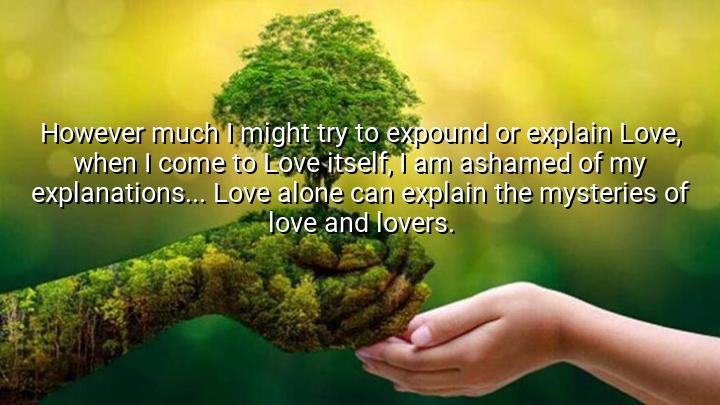




In this quote, Rumi reflects on the ineffable and transcendent nature of Love. He acknowledges that no matter how much he might try to explain or expound on the concept of Love, when confronted with the mysteries of love and the experiences of lovers, he feels inadequate in his ability to articulate its true essence. Rumi's words suggest that Love cannot be fully captured or conveyed through mere explanations or definitions, as it is beyond the realm of intellectual understanding.
Rumi emphasizes that Love alone holds the power to reveal its own mysteries. While humans may try to analyze or explain the nature of love, it is only through experiencing it that one can truly understand its depth and complexity. This perspective highlights Love’s ability to transcend logic and words, suggesting that the most profound understanding of love comes not from thought or reason, but from a deep, personal connection with it. Lovers themselves, through their emotions and experiences, are the only ones who can truly comprehend the power of Love.
The quote reflects Rumi's mystical beliefs, which often centered around the idea that the deepest truths of existence cannot be fully understood through intellect alone. Instead, Love is seen as a spiritual force that connects individuals to the divine and to each other. In this light, Rumi's statement is a reminder that some aspects of life, especially love, are meant to be felt and experienced, not rationalized or dissected.
Ultimately, Rumi’s quote celebrates the mystery and power of Love, recognizing that it cannot be neatly explained or contained within words. It invites individuals to embrace love in its purest, most experiential form, rather than seeking to understand it solely through intellectual frameworks. The beauty of love, according to Rumi, lies in its ability to remain mysterious and beyond explanation, offering a deeper connection to the divine and to each other.

HGph huong giang
There’s a haunting beauty in this quote, but also a bit of frustration. If love can’t be explained, how do we teach it, cultivate it, or heal from its absence? Is the unknowability of love what makes it so powerful—or so painful? I wonder if Rumi’s message is a warning against over-intellectualizing emotions, or simply a surrender to the mystery of the heart. Either way, it leaves me pondering.
DDLe Duy Dat
This quote makes me reflect on how language fails us sometimes. If love can only be explained by love itself, does that mean only those who have truly loved can recognize or validate it? That feels a bit exclusive. What about those still searching, or those who’ve been hurt and question what love is? Can one recognize love without fully experiencing it, or is it always an experiential truth?
NNLe Na Nguyen
I love how this quote blends humility and mysticism. Rumi seems to be surrendering to something bigger than intellect. But I’m wondering—how does this perspective align with modern psychology’s attempts to analyze love scientifically, through attachment styles, neurochemistry, etc.? Are those approaches inherently flawed because they strip love of its mystery, or are they just different lenses for exploring the same truth?
MDmanh dung
Is Rumi implying that rationality and language are useless when it comes to love? If so, what does that mean for people who process emotions through logic or who need clarity in relationships? This quote makes me wonder if our inability to explain love leads to miscommunication between partners. Can we truly connect without a shared language around our feelings, or is the mystery part of the magic?
CTtoi khong co ten
I feel seen by this quote. Every time I’ve tried to explain why I love someone, I fumble. It’s reassuring to hear that even a mystic like Rumi felt inadequate in the face of love. But it also makes me wonder—should we stop trying to define it altogether? Or is the act of attempting to describe love part of the experience itself? Is love meant to be felt more than understood?