

I have no companion but Love, no beginning, no end, no dawn. The Soul calls from within me: 'You, ignorant of the way of Love, set Me free.'
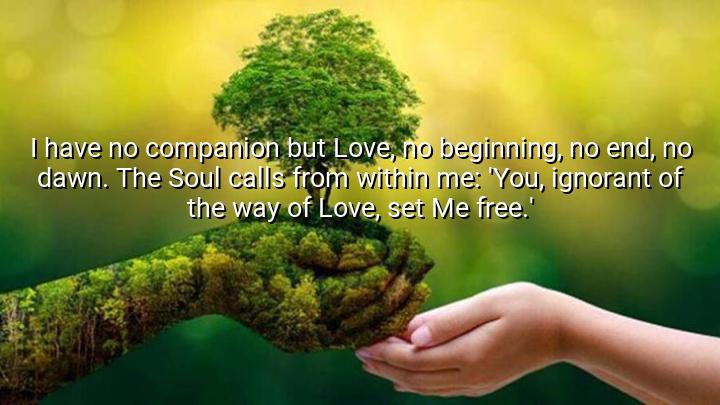




In this quote, Rumi speaks to the profound and all-encompassing nature of Love. He expresses that Love is not just an external experience or something that can be limited by time or space—it is his only true companion, transcending any concepts of beginning, end, or dawn. By saying, "no beginning, no end, no dawn," Rumi suggests that Love is eternal, a force that exists beyond the confines of human understanding and linear time. It is the Soul within him that calls out, urging him to understand and experience Love as a boundless, timeless presence.
The second part of the quote speaks to the spiritual awakening that comes with embracing Love. The Soul within Rumi calls out to be freed, urging him to break free from ignorance and to understand the deeper truths about Love. The phrase, "You, ignorant of the way of Love, set Me free," reflects the belief that human beings are often disconnected from the true essence of Love. We may experience superficial or conditional forms of love, but the true nature of Love is divine, boundless, and pure, requiring liberation from ignorance or worldly attachments.
Rumi’s words emphasize that the true nature of Love is not something that can be captured or confined by external circumstances. It’s an inner journey, a spiritual awakening that calls each person to release their preconceived notions and limitations. For Rumi, this understanding of Love is the path to spiritual freedom, as it transcends ego and worldly desires. The realization that Love is the ultimate force of unity is central to much of Rumi's mysticism and poetry, where he often describes Love as the force that unites the soul with the divine.
The origin of this quote comes from Rumi, a 13th-century Persian poet, theologian, and mystic. His works, written in the context of Sufism (a mystical branch of Islam), focus heavily on themes of divine love, spiritual enlightenment, and the connection between the human soul and the divine. Rumi's poetry is revered worldwide for its depth, universal appeal, and timeless wisdom, with his writings continuing to inspire people of various spiritual and religious traditions today.

AAdministratorAdministrator
Welcome, honored guests. Please leave a comment, we will respond soon