

The garden of love is green without limit and yields many fruits other than sorrow or joy. Love is beyond either condition: without spring, without autumn, it is always fresh.
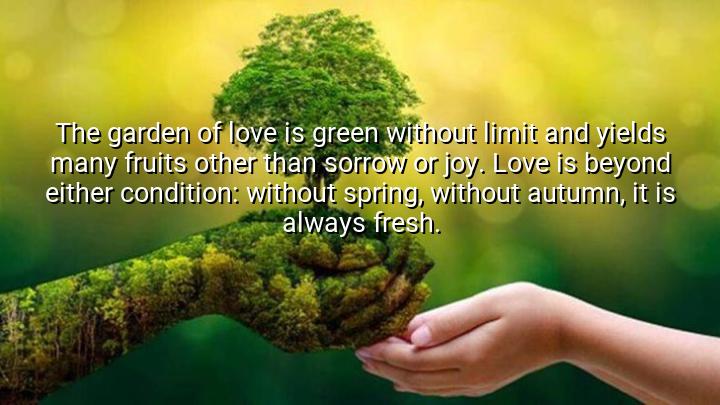




In this quote, Rumi, the 13th-century Persian poet and mystic, beautifully portrays love as an eternal and limitless force, transcending the typical emotions of sorrow and joy. The phrase "The garden of love is green without limit" symbolizes a never-ending abundance of love, one that is not confined by seasons or emotional extremes. Rumi suggests that love, in its purest form, is an ongoing source of growth and vitality, always flourishing regardless of the changing conditions of life. It is not bound by the typical cyclical nature of human experiences such as spring or autumn, representing the transient nature of life and emotions.
Rumi’s assertion that love "yields many fruits other than sorrow or joy" further emphasizes its infinite nature. While joy and sorrow are common and fleeting human emotions, love surpasses them by offering a more profound, ever-present quality. It is not something that simply comes and goes with mood or circumstance but rather a constant source of nourishment and transformation. This speaks to the mystic’s idea that true love is not limited to our ordinary experiences but exists on a much deeper, more spiritual level.
By stating that love is "always fresh," Rumi reminds us that love, when it is genuine and spiritual, remains vibrant and alive regardless of external circumstances. This timeless freshness contrasts with the human tendency to view love in terms of phases or seasons, where it is sometimes seen as something that fades or grows stagnant. For Rumi, love is eternal, untouched by time, and always renewing itself in the hearts of those who experience it.
The origin of this quote is rooted in Rumi’s teachings, which often explored the nature of spiritual love, the connection between humanity and the divine, and the idea that love is the force that connects all existence. Through his poetry and philosophy, Rumi sought to transcend the limitations of human understanding, pointing toward a love that is not only beyond worldly experiences but also a path to enlightenment and union with the divine. His work has continued to inspire and influence spiritual thinkers around the world, making him one of the most celebrated figures in mystical poetry.

AAdministratorAdministrator
Welcome, honored guests. Please leave a comment, we will respond soon