

Good art is art that allows you to enter it from a variety of angles and to emerge with a variety of views.
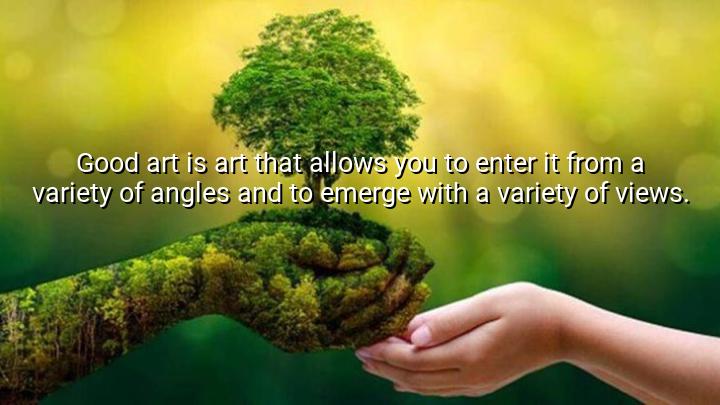




The quote "Good art is art that allows you to enter it from a variety of angles and to emerge with a variety of views" by Mary Schmich highlights the idea that true art is multi-dimensional and open to interpretation. Schmich suggests that art should not be limited to a single perspective or a one-dimensional experience. Instead, it should offer depth, inviting viewers to explore it from different viewpoints, each of which might reveal new meanings or insights.
In this context, art is seen as a dynamic and interactive experience. A piece of art that allows multiple interpretations encourages the audience to engage with it on a deeper level, where each interaction leads to different emotions, thoughts, or conclusions. Good art does not impose a single, fixed meaning but instead opens up a space for personal reflection, offering richness and complexity that evolves with each encounter.
The origin of this quote reflects Schmich's broader view on creativity and expression, as she is known for her work as a journalist and columnist, often reflecting on life’s complexities. Her perspective on art aligns with her belief in the value of diversity, openness, and multiple viewpoints. Art becomes a tool for exploring the world from various angles, making it a more universal and inclusive form of communication.
By stating that good art is one that allows a variety of views, Schmich emphasizes the importance of complexity and accessibility in creative work. Such art invites ongoing exploration and reflection, offering new revelations each time it is experienced. This makes art not just a passive object but an evolving conversation that can be interpreted differently by each viewer, contributing to its enduring value.

KLKyeu Ly-nh
What strikes me about this quote is its implicit suggestion that art is a mirror rather than a message. It adapts to the viewer, rather than dictating a singular meaning. But then, is art still meaningful if everyone sees something different in it? Or does that diversity of understanding dilute the artist's original intent? I’d love to hear what artists think of this idea—does it empower or frustrate them?
NQle thi nhu quyen
This quote reminds me of how differently my friends and I react to the same artwork. One of us might find it liberating, another might find it disturbing. That divergence isn't a weakness of the art—it’s the strength. But I wonder: is this a modern perspective? Historically, didn’t many artistic movements demand a more unified interpretation or ideology? Has our definition of 'good' art evolved to prioritize flexibility over clarity?
HLHoang Linh
The idea that good art invites multiple perspectives makes me think of how cultural and personal contexts shape interpretation. For example, someone growing up in a war-torn country might see something very different in a painting than someone raised in peace. Is the 'goodness' of art tied to its adaptability across diverse life experiences, or can deeply niche art also be considered valuable in its own right?
VGVanh Gg
I think this quote highlights what makes art so powerful—it’s a conversation, not a conclusion. When I view art, I’m not just looking at what’s there, but also bringing in my experiences, emotions, and worldview. That interplay is beautiful. But does this mean that hyper-specific or autobiographical art loses value because it doesn’t allow for such a wide range of interpretations? That’s an interesting paradox to explore.
NNAnh Nguyet Nguyen
I love how this quote celebrates ambiguity in art. It reminds me of great literature or film—where each revisit brings a new insight. But what about art that’s intentionally cryptic or inaccessible? Does that still qualify as 'good' by this standard? I’d be curious to know if Schmich is suggesting that relatability and open interpretation are prerequisites for artistic excellence, or just one of many valid approaches.