

Friendship is unnecessary, like philosophy, like art... It has no survival value; rather it is one of those things that give value to survival.
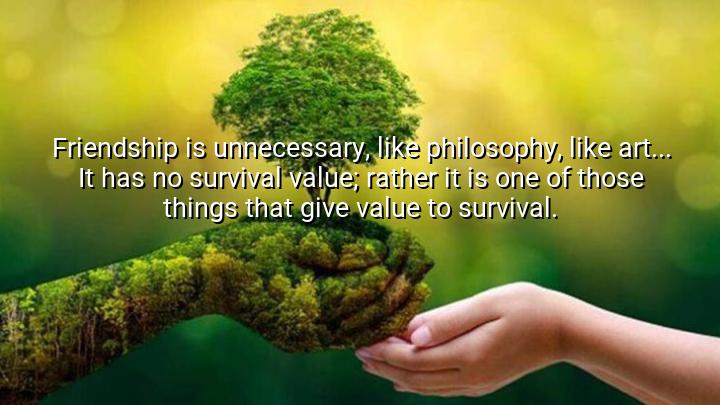




In this quote, C. S. Lewis reflects on the nature of friendship, suggesting that, while it may not be essential for survival, it is one of the things that makes life worth living. He compares friendship to philosophy and art, which, like friendship, are not necessary for basic survival, but they add meaning, purpose, and depth to our existence. Lewis emphasizes that these intangible aspects of life do not fulfill practical needs, but instead enhance the quality of life, making survival more enriching and fulfilling.
The origin of this quote comes from Lewis' broader views on human relationships and the deeper purposes of life, which he explored in his writings, both fictional and philosophical. Known for works like The Chronicles of Narnia and Mere Christianity, Lewis often contemplated the importance of the non-material aspects of life—such as love, art, and friendship—that go beyond the physical or survival needs. His philosophy suggests that while humans may need food, shelter, and safety to survive, it is the more abstract, emotional connections that truly give life meaning.
Lewis’ assertion that friendship, philosophy, and art are not necessary for survival but are integral to giving value to survival suggests that these elements are part of what makes life deeply human. Without them, life might be sustained, but it would lack the richness and joy that come from meaningful connections, intellectual exploration, and creative expression. These aspects, while not survival tools, provide the emotional nourishment that makes life worth living.
Ultimately, this quote reminds us that life is not just about enduring but about finding meaning in our experiences. Lewis suggests that friendship and other non-essential aspects of life are essential in creating a world where survival is not merely about existing but about thriving. These pursuits elevate our existence and give us something to aspire to beyond mere survival.

NHLe Ngoc Huyen
I absolutely love this quote—it feels like a defense of the human spirit. Still, I’m curious: how does this idea sit with people who are in survival mode, literally or emotionally? When you're struggling just to make it through the day, can friendship and art still hold value, or do they become burdens? I think C.S. Lewis is right, but I’d like to explore how this sentiment holds up in crisis or hardship.
P725 Anh Phu 7/1
This is a quote that really speaks to the soul. But does it suggest that we've created a world where emotional needs are treated as luxuries? If friendship and philosophy are framed as 'unnecessary,' are we more likely to neglect them? I worry that in striving to 'survive,' we’re letting go of the very things that make survival worthwhile. How can we shift our culture to protect these vital, intangible aspects of life?
DTDuong Tran
The quote resonates with me, especially in our increasingly utilitarian world. We often measure value based on productivity or utility. But friendship, like philosophy, enriches our inner life in ways nothing else can. That said, I wonder—can something that gives life meaning really be considered 'unnecessary'? Isn’t that the ultimate necessity? C.S. Lewis makes a compelling point, but I also think the distinction between necessity and value is more fluid than we admit.
KTKhanh Tran
This makes me wonder about how society prioritizes different values. If friendship and art aren’t essential to survival, why do they feel absolutely vital to our happiness? Should schools and governments put more emphasis on nurturing these 'non-essential' things? I feel like our world might be healthier emotionally if we treated love and beauty as integral instead of optional. Do others feel the same way, or is this just idealistic thinking?
BHBich Hang
I find this quote beautiful and deeply moving. It reframes how we think about what's 'necessary' in life. It makes me ask: are we too focused on what keeps us alive biologically, and not enough on what gives life emotional or spiritual depth? Why do we often undervalue things like friendship, art, or philosophy just because they don’t contribute directly to survival? Isn’t that missing the point of living altogether?