

Fortunately art is a community effort - a small but select community living in a spiritualized world endeavoring to interpret the wars and the solitudes of the flesh.
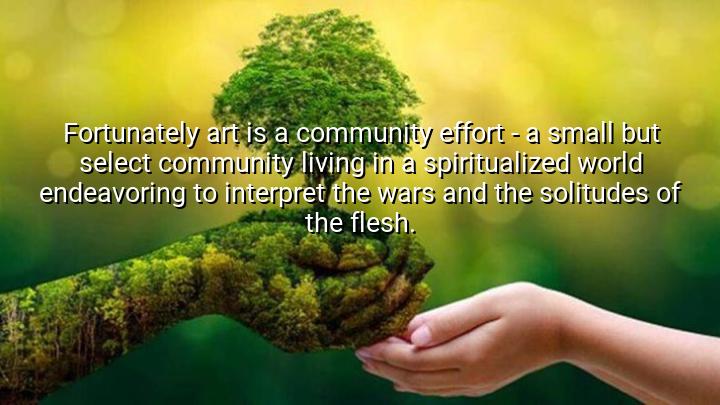




Allen Ginsberg’s quote, "Fortunately art is a community effort - a small but select community living in a spiritualized world endeavoring to interpret the wars and the solitudes of the flesh," underscores the collective nature of art and the deep, often spiritual connection shared among artists. Ginsberg emphasizes that while art may be produced by individuals, its creation and impact are deeply rooted in a community of like-minded people, each contributing to a larger understanding of the human experience. The phrase "small but select community" suggests that this group is not necessarily large but is formed by those who are particularly attuned to the spiritual and transformative power of art.
The "spiritualized world" that Ginsberg refers to implies that artists operate on a different level of consciousness or awareness, seeking to transcend the everyday and connect with deeper, more profound aspects of existence. For these artists, art is not just a form of self-expression; it is a way to explore and understand complex human conditions such as war and solitude. These are the "wars" of both the external world and the inner struggles of the self, which artists aim to represent and interpret through their work.
Ginsberg also touches on the idea that art reflects the solitudes of the flesh, referring to the individual experience of human suffering, isolation, and personal conflict. Artists, in Ginsberg’s view, are not just observers of society but active participants in interpreting the human condition, using their creative work to give voice to the struggles of both the body and the mind. This interpretation of life’s tragedies and joys is what makes art so vital, allowing it to communicate complex emotional and social themes.
Ultimately, Ginsberg’s quote highlights the role of art in providing meaning and connection. While the act of creating may be individual, the broader community of artists helps to elevate these works into something larger, capable of speaking to the shared human experience. Art, therefore, serves as a collective effort that helps us make sense of both the external conflicts and internal turmoil we face, offering a spiritual and emotional bridge between individuals and society.

NHnguyen nhat hang
I’m fascinated by the idea that art is a 'community effort' even though it’s often created in solitude. How does that paradox work? Is it because artists are unconsciously in dialogue with each other—responding to shared human conditions through different mediums and eras? It makes me think about how artists influence one another without ever meeting, and how that might shape the ongoing evolution of what we call art.
KKBui Thi Kim Khanh
This line really stuck with me because it reframes art as a communal response to suffering. But I’m left wondering: does that mean joy, pleasure, or ordinary life don’t belong in this 'spiritualized' artistic world? Can artists also come together to interpret peace, love, or simplicity with the same seriousness? Or is Ginsberg speaking from a specific cultural and emotional moment tied to trauma and rebellion?
TPPhan Thien Phu
What strikes me is how Ginsberg ties the physical—‘wars and solitudes of the flesh’—to the spiritual. Do you think that’s what gives art its power, the ability to transcend the body through shared emotional experience? I’m curious whether all forms of art strive for that kind of interpretation, or if some are just about beauty, humor, or play. Does art always need to be that deep?
THTran Hoan
I find this quote deeply moving. It suggests that art is a kind of shared mission to process the pain and isolation of being human. But I wonder—does the ‘community’ he’s talking about actually collaborate, or is it more of a spiritual kinship across time and space? How do individual artists stay connected to this collective effort, especially in a world that often isolates creators?
TTToi Ten
Ginsberg’s words made me feel both inspired and uneasy. The idea that artists live in a 'spiritualized world' sounds beautiful, but does that create a kind of elitism around art? What happens to those who feel artistic but don’t consider themselves part of this select community? Can art still be authentic or powerful if it comes from outside that spiritual realm he describes?