

Extreme complication is contrary to art.
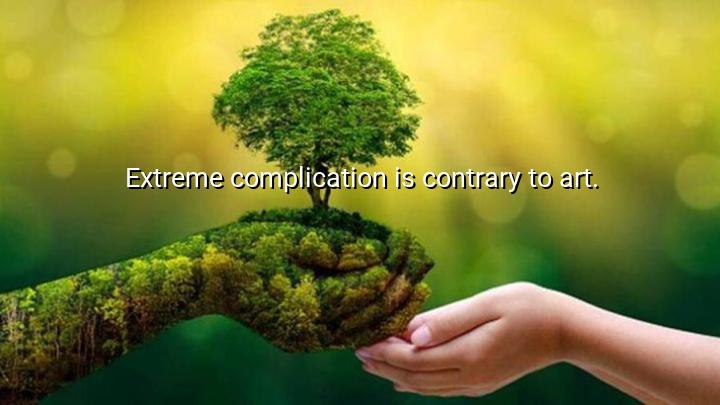




Claude Debussy’s quote, “Extreme complication is contrary to art,” reflects his belief in the power of simplicity, clarity, and emotional expression in artistic creation. As a composer known for his innovative and atmospheric music, Debussy rejected overly complex, rigid structures that dominated much of the Romantic and academic traditions of his time. In this quote, he argues that when art becomes excessively complicated, it loses its essence and accessibility, distancing both the creator and the audience from its emotional core.
Debussy was a key figure in Impressionist music (though he disliked the label), and his compositions often focused on tone color, mood, and suggestion rather than elaborate formulas or technical display. This quote is consistent with his musical philosophy—valuing naturalness and immediacy over artificial intricacy. For Debussy, beauty in art should emerge from fluid expression, not from rigid technical structures or showy complications.
The phrase “contrary to art” is crucial—it suggests that excessive complexity actually undermines what art is meant to do: move, connect, and communicate. Whether in music, painting, or literature, Debussy believed that artistic impact is not about how many layers or techniques one can use, but about how effectively and gracefully an idea or feeling can be conveyed. Overcomplication, in his view, can create distance rather than intimacy with the viewer or listener.
Ultimately, Debussy’s quote is a defense of elegant simplicity and a reminder that restraint can be more powerful than excess. It reflects a broader artistic principle: that true mastery often lies not in how much you can add, but in how much you can strip away while still saying something meaningful.

TQDung Dang Tran Quang
Debussy’s take feels refreshing in a world that often equates complexity with genius. It reminds me that clarity, beauty, and emotional resonance can get lost in the noise of overthinking. But I do wonder—aren’t there some cases where complexity enhances the experience, like in progressive rock or intricate architecture? Maybe it’s not about avoiding complexity entirely but ensuring it serves a greater purpose. When does detail become distraction?
UGUser Google
This quote makes me think about the role of intuition in creating and experiencing art. Is Debussy suggesting that great art should feel natural or effortless? Sometimes when I see a piece that’s overworked or too layered, it feels like it’s trying to prove something instead of just existing. Do you believe that the best art comes from stripping things down rather than piling more on? What’s the value of restraint in creativity?
CTchinh tran
As someone who appreciates minimalism, I resonate with Debussy’s statement. But then I think about composers like Bach or artists like Escher, whose works are highly complex yet undeniably beautiful. So, is the issue really 'extreme' complication, or complication without purpose or harmony? Maybe Debussy was cautioning against indulgence in cleverness when it comes at the expense of meaning or emotional connection. What do you think defines the tipping point?
DKNguyen Duy Kien
I love the idea that art should strive for elegance rather than density. Debussy’s comment makes me wonder—has modern art, in trying to innovate, drifted too far into complication for complication’s sake? Think of some contemporary installations or avant-garde music that feel more like puzzles than expressions. Do you think we've lost touch with the emotional essence of art in favor of complexity that impresses but doesn’t move?
GNThu Giang Nguyen
This quote hits differently in today’s world, where so much art seems to celebrate intricacy, abstraction, and layers of meaning. Is Debussy warning us against art that becomes too intellectual, too inaccessible? I sometimes feel overwhelmed by art that demands so much interpretation. Should good art speak more directly to the senses and the soul rather than require academic decoding? I'd love to hear others’ take on this.