

Every good painter paints what he is.
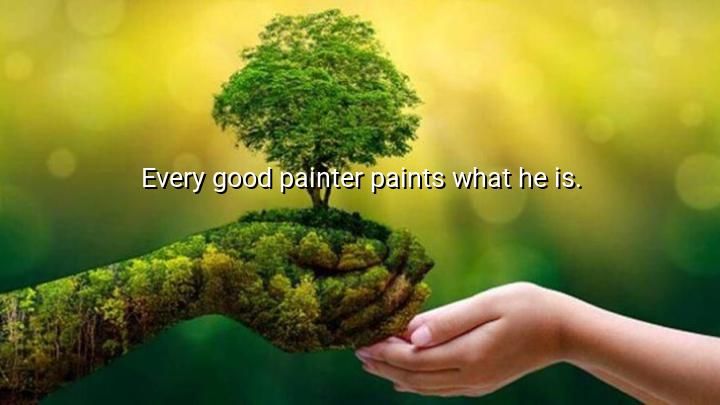




The quote "Every good painter paints what he is" by Jackson Pollock emphasizes the idea that an artist’s work is deeply tied to their personal identity and inner world. Pollock, a leading figure in the Abstract Expressionist movement, believed that art is an expression of the artist’s emotions, thoughts, and experiences. By stating that a good painter paints "what he is," Pollock suggests that the true value of art lies in its authenticity—an artist’s work should reflect their essence and the unique perspective they bring to the world.
Pollock’s statement also reflects his belief in the importance of personal expression in art. For him, painting was not about replicating the external world or adhering to traditional forms, but about channeling the artist’s internal state into the canvas. Art becomes a direct reflection of who the artist is, in a way that transcends technique or subject matter. This perspective aligns with his own work, where his drip paintings were a physical manifestation of his emotional energy and subconscious expression.
In the context of Abstract Expressionism, Pollock’s quote challenges the notion that art must adhere to specific rules or external standards. Instead, it highlights the idea that the artist’s personal journey, struggles, and emotions are central to the creative process. The artist’s identity—who they are, what they feel, and how they see the world—becomes the foundation of the work itself.
Ultimately, Pollock’s quote speaks to the importance of authenticity in art. A good painter, according to Pollock, is not someone who simply replicates the world around them, but someone who paints from their own experience and inner truth. This approach makes the art a unique reflection of the artist’s spirit, offering viewers a glimpse into the artist’s personal worldview.

ATLan Anh Tran
Pollock’s idea makes me reflect on the emotional transparency of artists. If painting what you are is the goal, then creating art becomes a sort of confession. That’s powerful but also kind of scary. Are all artists prepared to be seen like that? And as viewers, do we always recognize what they’re showing us, or do we just project our own interpretations onto their work?
ANAn Nguyen
I wonder how this idea holds up in collaborative art or commissioned work. If a painter is hired to produce something specific, can they still infuse it with their identity? Or does the act of creating for others dilute the self-revealing nature Pollock talks about? This raises questions about the line between art and commerce, and whether personal truth can survive the pressures of external expectations.
T928. Le Thi Thu Trang 9/11
I think there’s a quiet challenge in this quote. It’s as if Pollock is saying that good art demands honesty—emotional, psychological, maybe even spiritual. But what if someone doesn’t fully know who they are yet? Can self-discovery happen through the act of painting? Or is there a risk that people might imitate others or chase styles instead of painting from their own truth? This feels like a call for introspection more than anything else.
NHHai Hoang Nguyen Huu
Pollock's quote strikes me as deeply personal, even a bit vulnerable. It assumes that authenticity is the essence of good art. But what about technical mastery or storytelling? Are those less important than personal expression? I'm curious whether this perspective leaves room for artists who treat painting more like craft than catharsis. Is there still value in art that doesn’t expose the painter’s inner world?
UGUser Google
This quote makes me wonder: is it even possible to separate the artist from the art? If a good painter paints what he is, does that mean every brushstroke is a self-portrait in some form? I find that fascinating. But then, what about artists who create fantastical scenes or work in abstract forms—are they still revealing their true selves, or are they intentionally disguising them? Can fiction still be confession?