

Every art and every inquiry, and similarly every action and choice, is thought to aim at some good; and for this reason the good has rightly been declared to be that at which all things aim.
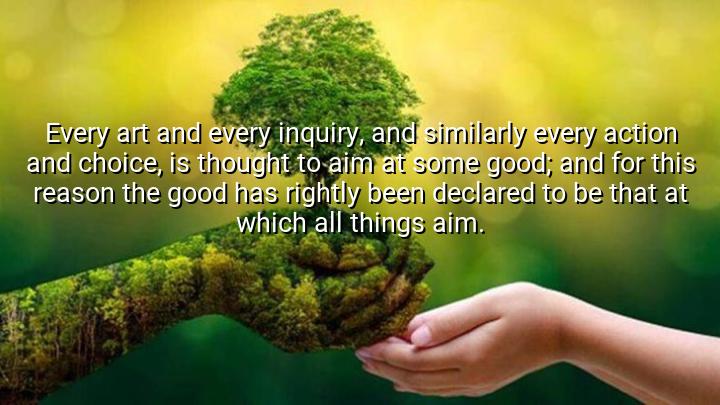




Aristotle’s quote, "Every art and every inquiry, and similarly every action and choice, is thought to aim at some good; and for this reason the good has rightly been declared to be that at which all things aim," reflects his ethical philosophy, particularly the concept of the good. Aristotle argues that all human activities, whether they are artistic, intellectual, or practical, are directed towards some purpose or end that is perceived as good. In his view, everything we do, from creating art to making decisions, ultimately aims to achieve some form of well-being or flourishing (which he calls eudaimonia).
The phrase "the good has rightly been declared to be that at which all things aim" suggests that goodness is the ultimate goal of human life. Whether through art, science, morality, or any other endeavor, the idea of the good serves as a guiding principle that shapes our actions and choices. Aristotle’s belief is that all human activities are driven by the desire to achieve something that enhances our life or contributes to our well-being, and therefore, the good is central to the purpose of everything we do.
Aristotle’s perspective challenges the notion that people act randomly or without purpose. Instead, he sees every action as motivated by a desire to improve one’s circumstances, whether in the immediate or long term. For instance, creating a piece of art or engaging in scientific inquiry might be driven by a desire to create beauty, understand the world, or bring benefit to society. In each case, the pursuit of the good is a key underlying force.
Ultimately, Aristotle’s quote highlights the teleological nature of his philosophy, where all things are thought to have a purpose, and that purpose is intrinsically tied to achieving goodness. This is a foundational concept in his Nicomachean Ethics, where he explores how human beings can live a fulfilled and virtuous life by aligning their actions with the pursuit of the good. The idea that everything aims at the good reinforces the view that we are all motivated by the desire to live well, making ethical choices in the process.

MPHa thi minh phuong
This quote really resonates with the idea of purpose. If everything we do is ultimately a search for some kind of good, then even our failures might have value in that context. I’m curious—how would this apply to art that deliberately seeks to disturb or provoke discomfort? Can disruption itself be a kind of good? Maybe Aristotle’s framework invites us to broaden our understanding of what ‘good’ can look like.
BTBa Tran
There’s something comforting about the idea that all art, inquiry, and action aim toward some good. But how does this view hold up in today’s world, where motivations are often clouded by profit, ego, or power? Do those aims still qualify as 'good' by Aristotle's standards, or is he referring to a more virtuous, collective good? It makes me wonder how this idea fits into contemporary ethics and politics.
BCBao Chau
This line seems incredibly idealistic. I wonder if it's more of a philosophical aspiration than a universal truth. Are there not people or systems that operate out of malice or indifference, with no real aim at the 'good'? Or does Aristotle mean 'good' in a broader, more subjective sense? It feels like a deep question about the nature of motivation itself. How do we even define what 'good' is universally?
UGUser Google
I'm fascinated by how this quote connects ethics with intention. If every choice aims at some good, how do we account for mistakes or morally ambiguous actions? Is Aristotle suggesting that even harmful decisions come from a place of seeking some perceived benefit? It raises the question of whether morality is more about outcome or intention. Can a wrong action be justified if the aim was believed to be good?
NHnhung hi
This quote makes me think—do all actions truly aim at some form of good, or is that just how we rationalize our behavior after the fact? Sometimes people knowingly pursue harmful or selfish paths. Does that mean they view those actions as 'good' for themselves, even if society sees them otherwise? I'm curious how Aristotle would handle the concept of 'evil' under this framework. Is it just a misguided pursuit of good?