

Each player must accept the cards life deals him or her: but once they are in hand, he or she alone must decide how to play the cards in order to win the game.
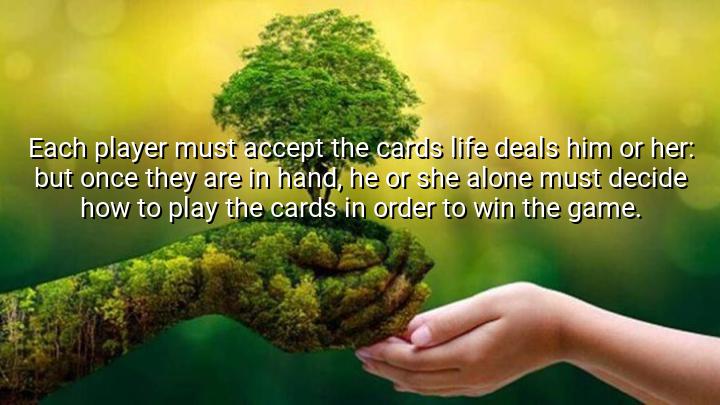




The quote "Each player must accept the cards life deals him or her: but once they are in hand, he or she alone must decide how to play the cards in order to win the game" by Voltaire emphasizes the importance of personal responsibility and decision-making in life. Voltaire suggests that while we cannot control the circumstances or challenges we are given (the cards life deals us), it is up to us to determine how to respond to these challenges. Our ability to navigate life’s difficulties and make decisions based on the situation we face is crucial to our success and growth.
Voltaire, a French philosopher and writer during the Enlightenment, was known for his advocacy of reason, individual freedom, and social progress. This quote reflects his belief in personal autonomy and rationality. Voltaire often championed the idea that individuals should take ownership of their lives and not passively accept their fate, but rather actively engage in shaping their own destiny through the choices they make.
The phrase "he or she alone must decide how to play the cards" underscores the idea that personal agency is crucial. While external factors may influence our lives, the way we handle and interpret those circumstances determines the outcome. This emphasizes self-reliance and the notion that we are responsible for our own actions, regardless of the situation or the difficulties we face.
Ultimately, Voltaire’s quote teaches that life is about more than just enduring challenges—it is about actively choosing how to face them. The key to winning the game of life lies in decision-making, adaptability, and the courage to take responsibility for the actions we take, rather than blaming external forces for our situation. By embracing this mindset, we gain control over our lives and create our own path to success.

HNHo Nhan
This feels like a very pragmatic worldview—accept what you can't change, and focus on what you can. But is that always emotionally realistic? What if someone can't get past grief, trauma, or regret over the hand they were dealt? Does this quote offer solace or pressure to move forward regardless? I admire the stoic tone, but I wonder how this lands for someone in pain or transition.
MLM LALISA
There’s something quietly harsh about this quote. It’s empowering, yes, but also kind of lonely. If each person is ultimately responsible for how they play their hand, where does mentorship or community fit in? Don’t we all need a little guidance sometimes? I agree that we make our own choices, but isn’t it also true that the best players often had great teachers?
GDGold D.dragon
I really like the metaphor here, especially how it captures the blend of fate and free will. But what about people who feel paralyzed by the cards they’re holding? Not everyone gets the tools or confidence to ‘play’ well. Should society play a role in helping others understand their hand and strategies? Or is Voltaire saying that no matter what, the final move is always ours to make?
GDGold D.dragon
This quote resonates with me as a reminder of agency, but I can’t help asking—what defines 'winning' in life? Is it success, happiness, legacy, or something else entirely? If we’re all playing different versions of the game, then isn’t how we play—and what we aim for—deeply personal? I love the metaphor, but it feels like the quote assumes a shared goal, when in reality, everyone's game might look different.
VQ33. Phan Van Quy
Is Voltaire suggesting that personal responsibility outweighs circumstance? I appreciate the empowering message here, but I wonder how this applies to people dealt truly difficult hands—poverty, discrimination, illness. Can everyone really ‘win the game’ just by making good choices? Or does this mindset risk ignoring systemic obstacles that some individuals face far more than others? It’s inspiring, but maybe oversimplified when applied universally.