

Don't only practice your art, but force your way into its secrets; art deserves that, for it and knowledge can raise man to the Divine.
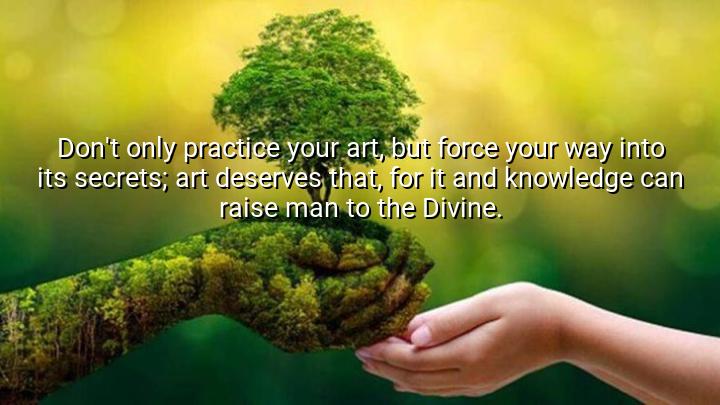




In this quote, Ludwig van Beethoven urges artists not just to practice their craft, but to actively pursue and uncover the deeper secrets of their art. Beethoven suggests that art is more than just a skill to be honed—it is a journey of discovery that requires dedication, passion, and an intellectual and emotional investment to truly understand its inner workings. The phrase "force your way into its secrets" emphasizes that an artist must go beyond surface-level practice and delve into the essence of their medium, striving for a deeper connection with their art.
Beethoven also links the pursuit of art and knowledge to the elevation of humanity. He believes that through art and the knowledge gained from it, a person can achieve a higher, almost divine state. Art, in this sense, is not only a creative endeavor but a spiritual and intellectual practice that has the power to transform the individual. By dedicating oneself to uncovering the mysteries of art, one can reach a state of higher consciousness and fulfillment, making the pursuit of art both a personal and transcendent experience.
The quote reflects Beethoven’s own intense commitment to his music and the profound effect it had on his life. As a composer who pushed the boundaries of music, especially as he faced the challenges of deafness, Beethoven’s own life exemplified the relentless pursuit of artistic and personal growth. He believed that great art had the potential to elevate not just the artist, but humanity as a whole, offering a glimpse into something greater than the ordinary human experience.
Ultimately, Beethoven’s quote speaks to the idea that art is not merely about technique or expression but is a powerful tool for self-discovery and spiritual growth. Through a deep and committed engagement with art, one can not only become a master of their craft but also experience a higher understanding of life, much like an artist or philosopher who seeks to uncover the mysteries of the world.

TMLe thao My
There’s something profound here about the relationship between art and transcendence. Beethoven seems to suggest that through rigorous artistic inquiry, we tap into something beyond ourselves. But in a world where art is often commercialized or rushed, how do we preserve that sense of reverence? Can modern artists still aim for the 'Divine' in a culture that values output over depth?
TTien
The phrase 'force your way' really stands out to me. It implies struggle, maybe even violence, against barriers to understanding. Is that how artistic growth really works? I’ve always thought of creativity as more intuitive, something that flows. This quote challenges that idea and makes me ask: is real artistry about effort and endurance more than inspiration?
KHKhanh Hien
What are these 'secrets' Beethoven talks about? Are they technical things—like mastering form and structure—or are they emotional truths, hidden meanings, maybe even spiritual revelations? I’d love to hear how others interpret this. And is it possible that each artist has to find their own secrets through their unique journey, rather than following a set path?
PLPhung Lan
I find this quote inspiring but also kind of intimidating. If art and knowledge can elevate us to something divine, does that mean those who don’t pursue them deeply are missing out on something essential? It makes me wonder whether everyone has access to this kind of artistic enlightenment, or if it's something reserved for the extraordinarily gifted or privileged.
THTran Hoai
This quote makes me think about how often we settle for surface-level competence in creative fields. Beethoven seems to be urging a more obsessive kind of learning, like an artist should become a kind of detective. But where’s the line between passionate exploration and burnout? Can the pursuit of artistic 'secrets' become toxic if we’re always striving toward something unreachable or undefined?