

Diversity: the art of thinking independently together.
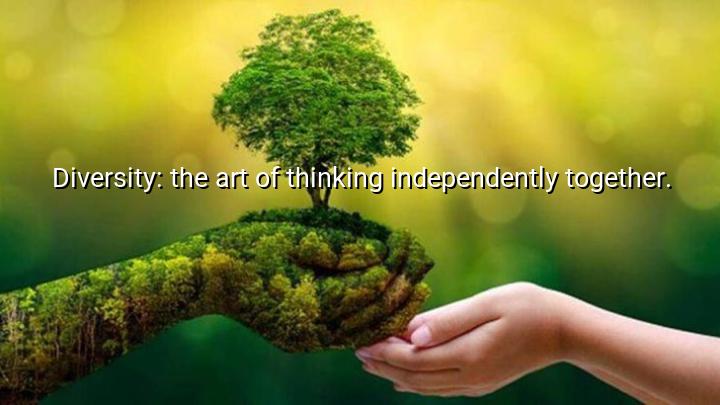




In this quote, Malcolm Forbes defines diversity as the ability for individuals to think independently while still coming together as a cohesive group. He emphasizes that true diversity is not simply about differing backgrounds or perspectives, but about fostering a collaborative environment where people bring their unique ideas, experiences, and viewpoints to the table, yet still manage to work together toward a shared goal. This balance between independence and unity allows for more creative solutions and richer outcomes than when everyone is forced to think in the same way.
The origin of the quote reflects Forbes’ perspective as a businessman and publisher, particularly in his leadership of Forbes magazine. Forbes understood that in a rapidly changing and interconnected world, success often depends on the ability to harness a wide range of perspectives and talents. His belief in collaboration across diverse groups was rooted in his experience within the corporate world, where diversity of thought can lead to innovation and competitive advantage.
Forbes’ idea of diversity as thinking independently together also points to the importance of mutual respect and open-mindedness in group settings. While independence allows for personal growth and innovation, coming together as a group ensures that these unique perspectives are integrated into a shared vision. This blend of individualism and collaboration can help solve complex problems and encourage progress in ways that a homogenous group might not achieve.
Ultimately, this quote highlights the power of diversity in fostering an environment where different perspectives are valued and brought together for a common purpose. Forbes suggests that the key to success in both business and society lies not in uniformity, but in the ability to combine independent thought with collective action, making diversity a powerful tool for innovation and growth.

QQuynh
This quote hits differently when you think about innovation. So many great ideas come from diverse teams, but only when everyone feels heard. It makes me ask—how do we avoid groupthink in environments that value collaboration? What structures or habits actually support independent thinking in a group setting? Maybe it’s less about who’s in the room, and more about how the room listens to each voice.
HNhieu nguyen
I really admire the optimism in this quote. It suggests that diversity is not just about difference, but about synthesis. But I wonder—what happens when independent thinking leads to deep moral or ideological divides? Can we still function 'together' if our foundational beliefs conflict? Is there a point where unity becomes impossible, or can shared goals always bridge even the widest gaps in perspective?
MMMinh Minh
This quote made me think of classrooms and how group projects often fall flat when real diversity of thought isn’t encouraged. We may come from different backgrounds, but are we really thinking independently together—or just conforming to get along? It’s a tricky balance. How can educators better design learning environments where students feel empowered to bring different ideas to the table without fear of rejection or conflict?
PTLinh Pham Thuy
I like the poetic feel of this quote, but I’m curious—how realistic is this in practice? People often say they want diversity, but when diverse opinions challenge the status quo, discomfort kicks in. Isn’t there a tendency to celebrate diversity only when it aligns with dominant views? How do we create psychological safety so that independent thinking can thrive in group settings without people feeling alienated or shut down?
NQKieu phan nhu quynh
This quote is beautifully paradoxical, and it makes me wonder—how do we truly foster an environment where independent thinking and collective engagement coexist? So often, diversity is framed as just demographic variety, but this feels deeper. Can organizations and teams actually embrace conflicting perspectives without losing cohesion? What kind of leadership or culture is needed to make space for both individuality and unity without one overpowering the other?