

Diplomacy: the art of restraining power.
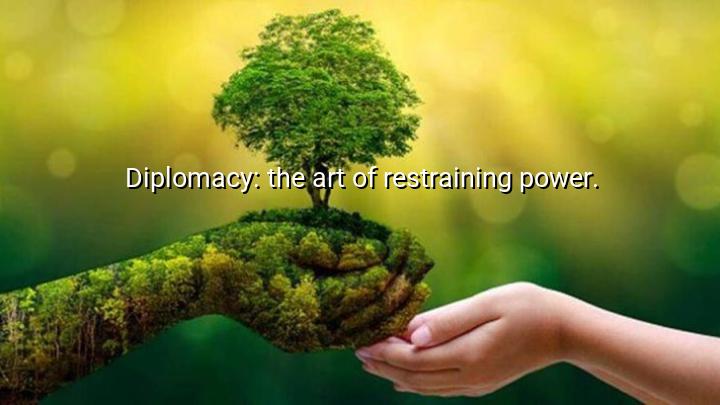




The quote "Diplomacy: the art of restraining power" by Henry Kissinger defines diplomacy as the delicate and skillful management of international relations through restraint rather than force. Kissinger, a former U.S. Secretary of State and National Security Advisor, is known for his expertise in foreign policy and his role in shaping global diplomacy during the Cold War. In this quote, he emphasizes that diplomacy is not about wielding power aggressively, but about using it in a controlled and measured way to maintain peace and stability.
Kissinger’s concept of diplomacy is rooted in the understanding that power alone cannot achieve long-term solutions to global issues. Rather than resorting to military intervention or coercive tactics, diplomacy involves negotiation, compromise, and dialogue to address conflicts and differences. Restraining power means recognizing the limits of force and the importance of communication and negotiation in achieving diplomatic goals.
The word art in the quote underscores that diplomacy requires skill, finesse, and careful judgment. It is not a mechanical process but a nuanced activity that involves understanding the perspectives and interests of others. True diplomats must know when to assert power and when to restrain it, using their influence to achieve objectives without escalating tensions unnecessarily.
In essence, Kissinger’s quote suggests that diplomacy is about managing power wisely, understanding its potential consequences, and choosing restraint when necessary. By doing so, diplomats can maintain stability, foster cooperation, and navigate the complexities of international relations without resorting to violence or unchecked aggression.

KNNgo Khanh Ngoc
Kissinger’s definition gives diplomacy a minimalist elegance, but I’m skeptical. Is diplomacy always about restraint, or sometimes just manipulation in a nicer suit? The phrase sounds principled, but in practice, doesn’t diplomacy often enable powerful nations to maintain their influence without accountability? I’m curious how this perspective plays out in post-colonial contexts, where ‘restrained’ power still causes long-term consequences. Is restraint enough when power structures are deeply unequal?
NLNg. Ly
This quote makes diplomacy sound almost noble, but I wonder—can power truly be restrained without being redirected or transformed? Restraint might prevent conflict temporarily, but does it resolve underlying tensions? It also raises a question about justice: does restraint sometimes come at the expense of action that could protect vulnerable groups? Is diplomacy too focused on maintaining balance rather than addressing moral imperatives?
TNthuanh nguyen
I appreciate how this quote implies that diplomacy is a form of discipline, not just strategy. It flips the usual image of power—suggesting that true strength lies in not using force. But here’s what puzzles me: does this definition assume that all power is potentially harmful? And if so, is diplomacy only effective in preventing damage, or can it also be constructive? That subtlety is worth unpacking.
BLBao Lam
Kissinger’s take on diplomacy feels like a warning about unchecked power. It makes me think about modern global conflicts—how much of what's called diplomacy is actually posturing, not restraint? I wonder whether current leaders still see diplomacy as an art, or if it’s more of a performance now. Can you think of recent moments where genuine restraint led to peace or resolution, rather than escalation?
THTu Huynh
This quote really struck me. It suggests that diplomacy isn't about showing strength, but rather about controlling it. That makes me wonder—how often is restraint actually more powerful than action? Can real influence come from holding back instead of pushing forward? It seems counterintuitive in a world that often rewards dominance, but maybe that’s the genius of diplomacy: subtlety, not spectacle. Does this idea apply to personal relationships too?